Pizza Dough Docker Uses for a Homestead Kitchen
Disclaimer: I received this item for free or at a reduced price in exchange for my honest, unbiased review. All opinions are my own.
I make homemade pizza dough a lot, and one of my favorite ways to make pizza night easier is to make extra dough and freeze it. Then, when I want pizza, I can thaw the dough, add whatever toppings I have on hand, and get dinner on the table without starting completely from scratch.
That is one reason I have kept a pizza dough docker in my kitchen for years. I originally received the Orblue Pizza Dough Docker for review, but it turned out to be one of those simple tools that had more uses than I expected. I have used it for pizza dough, homemade crackers, and pie dough, and there are several other kinds of dough where a docker can be useful when you want to control bubbling and get a more even bake.
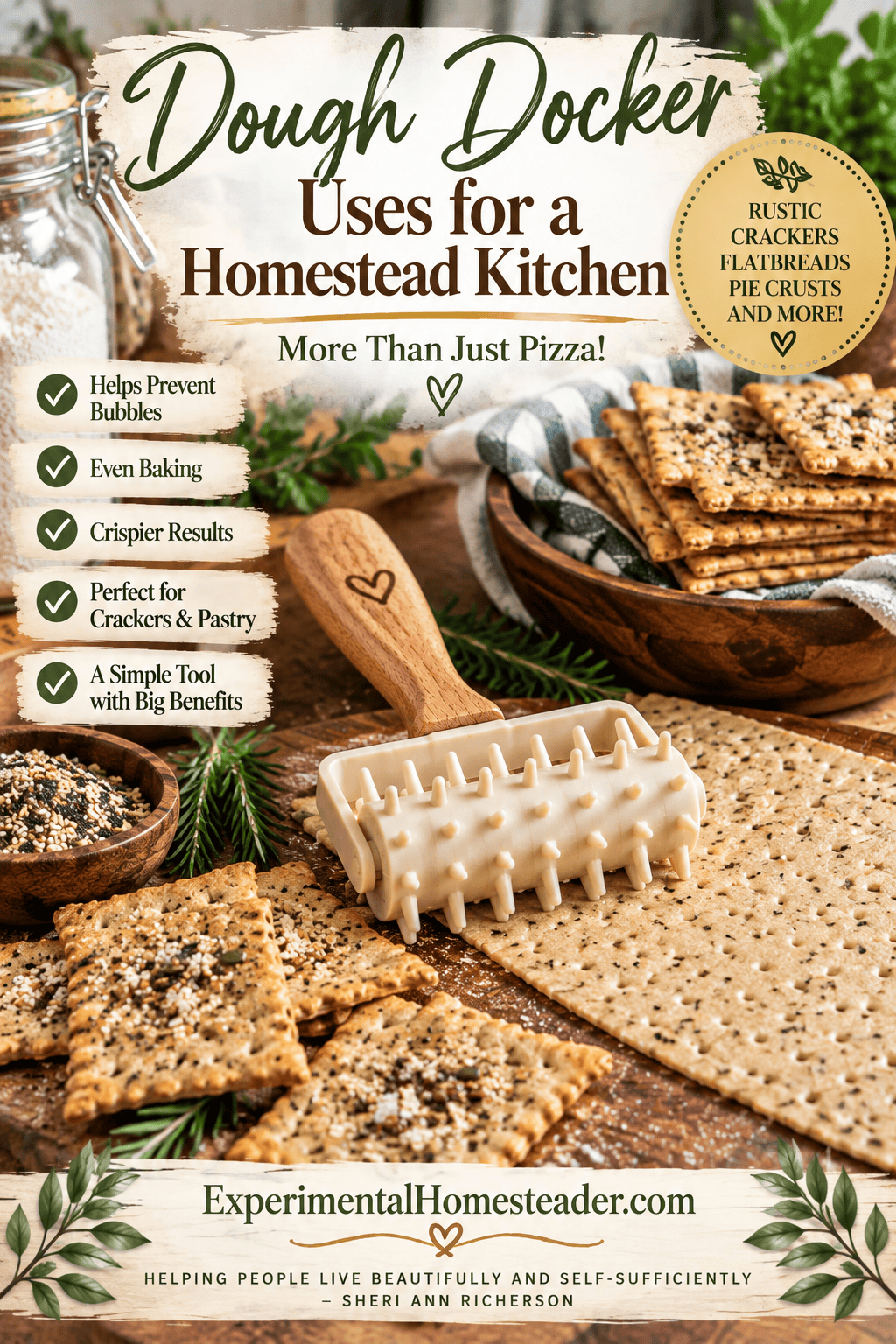
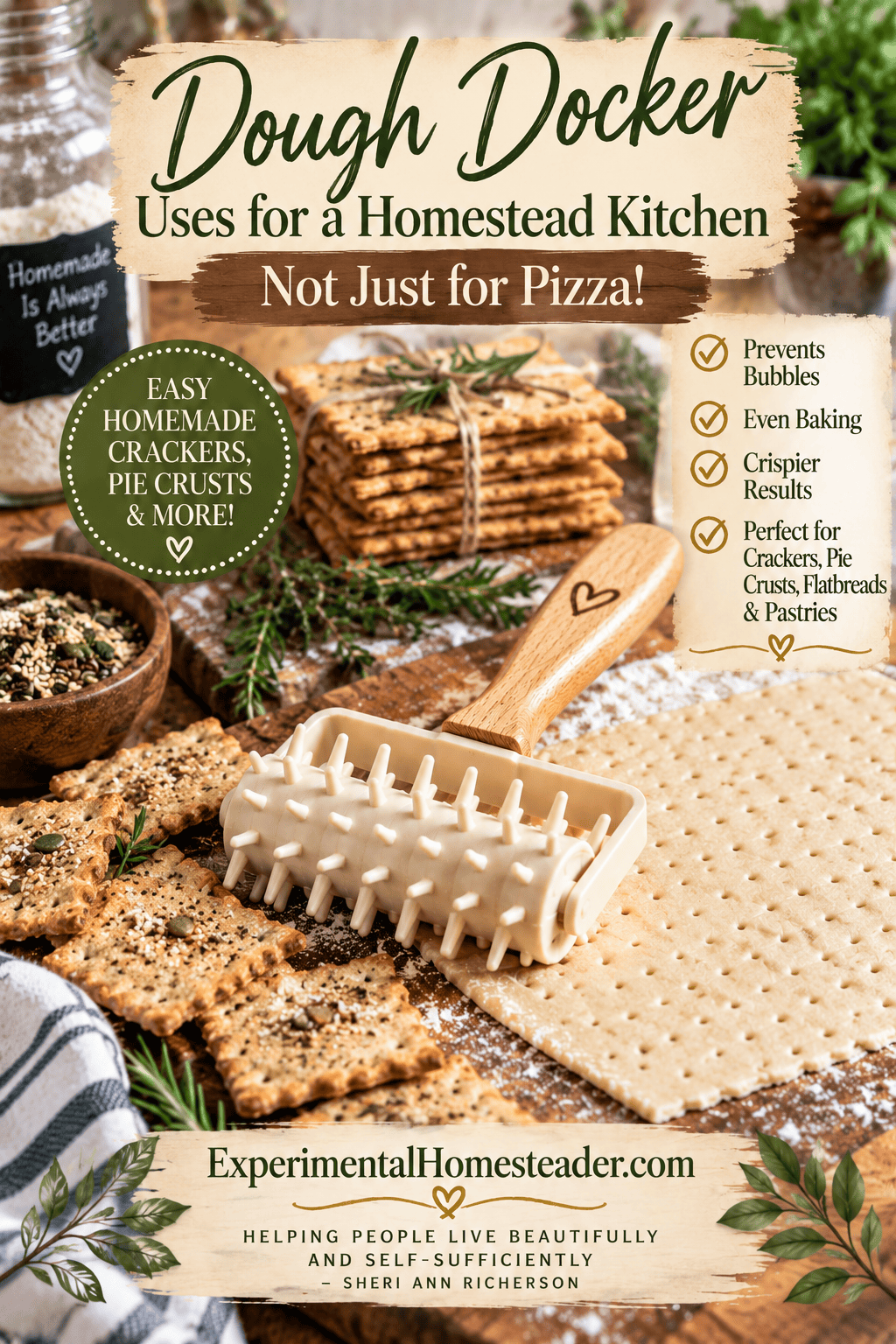
A dough docker is not a complicated kitchen gadget. It is basically a small roller covered with short points. You roll it across the surface of the dough before baking, and those little points make tiny holes that allow steam to escape. That helps prevent large air bubbles and uneven puffing.

In This Article
Why I Still Like a Dough Docker for Homemade Pizza
Pizza is one of those foods that fits very naturally into a homestead kitchen because it is so flexible. You can make the crust yourself, use homemade sauce, pull vegetables from the garden, use herbs you dried earlier in the season, add meat you already have in the freezer, or simply use whatever cheese and toppings are available.
It is also one of the easiest meals to prepare ahead. I love making pizza dough and freezing it because the hard part is already done when I need a quick meal. I can take dough from the freezer, let it thaw and come back to a workable temperature, roll it out, dock it, add toppings, and bake it.
That kind of convenience matters on a homestead. There are plenty of days when something takes longer than expected outside, an animal needs attention, a project runs late, or I simply do not want to spend the entire evening cooking. Homemade freezer dough gives me the convenience of a prepared food without giving up control over the ingredients.
The docker helps with the next step. Once the dough is rolled out, I run the docker across the center portion of the crust. I generally leave the outer edge alone if I want it to rise and form a thicker rim. The docked center is less likely to form those huge bubbles that push the toppings to one side or leave part of the crust much thicker than the rest.
What a Pizza Dough Docker Actually Does
When dough bakes, moisture turns to steam. If that steam becomes trapped between layers or underneath the surface of the dough, it can create bubbles. Sometimes bubbles are exactly what you want. Other times they are not.
A dough docker creates many small holes in the dough so some of that steam has an easy way to escape. The result is usually a flatter, more even surface.
This is especially useful for thin pizza crust, crackers, flatbreads, and crusts that are being baked before the filling goes in. It can also be helpful when you want a dough to stay relatively flat instead of developing random pockets.
It does not replace rolling the dough. I still roll or stretch the dough to the thickness I want first. The docker comes afterward. I roll it gently across the dough and let the little points do the work.
How I Use It With Pizza Dough
For pizza, I roll the dough out first and then use the docker over the area where the toppings will go. I do not need to press as hard as possible. The goal is simply to pierce the dough enough to create small steam vents.
If I want a raised outer crust, I avoid docking that edge. That lets the center stay flatter while the perimeter can still rise.
This works especially well for individual pizzas and thinner crusts. I also use this approach when I want the toppings to sit evenly instead of sliding toward a large bubble in the middle of the crust.
I have another article on individual homemade pizzas where I use this same tool for a thin crust. Individual pizzas are useful when people want different toppings, and they are also a good way to use several small amounts of leftovers without making one strange combination on a single large pizza.
Freezing Homemade Pizza Dough Makes Pizza Night Easier
One of the reasons I make pizza dough regularly is because it freezes so well. I would much rather spend a little extra time making a larger batch once than start from the beginning every single time we want pizza.
When I make extra dough, I divide it into pizza-size portions before freezing. That way I can thaw only what I need. A single portion is much more convenient than freezing one huge lump of dough and trying to divide it while it is still cold.
I lightly oil the dough and package it well so the surface does not dry out in the freezer. I also leave enough room in the packaging for a little expansion. Yeast dough can still have some activity as it cools down, so I do not pack it into something with absolutely no extra space.
When I am ready to use it, I thaw the dough and then give it time to lose the refrigerator chill before trying to stretch or roll it. Cold dough tends to fight back. Dough that has had time to relax is much easier to work with.
Once it is workable, I roll it out, use the dough docker, add sauce and toppings, and bake it just like fresh dough.
For me, this is one of those freezer habits that makes homemade food realistic instead of turning it into an all-day project every time. I am still making the dough myself. I am just doing the work at a time that is more convenient.

FROM MY HOMESTEAD SHOP
Keep Your Sourdough Pizza Experiments Organized
If sourdough pizza is part of your homemade pizza routine, my Ultimate Sourdough Planner gives you one place to track your starter, feeding schedule, baking plans, recipe variations and results.
It is especially useful when you are experimenting with crust recipes or making dough ahead for the freezer and want to remember what worked.
I Have Used the Dough Docker for Homemade Crackers Too
Crackers are another place where a dough docker makes sense. Homemade cracker dough is usually rolled thin, and large bubbles can leave part of a cracker puffy while another part stays flat.
Docking the dough before cutting and baking helps release steam and keeps the crackers more even. That is useful when I want crisp crackers rather than little air pillows.
This is also where the docker is much faster than poking every cracker repeatedly with a fork. A fork works, and there is nothing wrong with using one if that is what you have. But if I have a large sheet of cracker dough in front of me, rolling a docker across it takes seconds.
That is the kind of kitchen tool I appreciate: not something that replaces a basic skill, but something that makes a repetitive job faster.
I Have Also Used It for Pie Dough
Pie dough was another use I ended up finding for the docker. When a pie crust is baked without a filling, or partially baked before the filling is added, the bottom can puff up.
Docking can help reduce that puffing by giving steam a place to escape. Depending on the pie and the recipe, pie weights may still be appropriate, but docking is another useful tool for controlling how the crust bakes.
I would not automatically dock every pie crust. Some recipes need the dough left intact, and very wet fillings can potentially seep through holes in the crust. I use it when the particular crust and baking method benefit from it rather than treating docking as a rule for every pie.
Other Ways a Dough Docker Can Be Useful
I know I have used mine for pizza, crackers, and pie dough. Beyond those, there are quite a few other situations where a dough docker can be useful. These are not all things I am claiming to have personally made with this particular docker; they are simply examples of doughs where controlling bubbles or puffing can be helpful.
- Flatbreads: Some flatbreads are meant to stay relatively flat and benefit from docking before baking.
- Lavash: Thin, crisp lavash is a natural candidate because docking helps discourage large bubbles.
- Thin breadsticks: If you roll breadstick dough into flat strips, docking can help them bake more evenly.
- Tart shells: Tart dough that is blind baked may benefit from docking for the same reason pie crust does.
- Pastry bases: Savory pastry bases that need to remain flat under toppings or fillings can sometimes be docked before baking.
- Calzone or stuffed-dough components: While I would not dock the sealed top of a stuffed dough indiscriminately, a docker can be useful when preparing flat dough components where you want to control puffing before assembly.
- Thin focaccia-style bases: Traditional focaccia is intentionally dimpled and allowed to rise, so a docker is not necessary for classic focaccia. But for very thin, pizza-like focaccia bases, light docking can be useful depending on the texture you want.
- Pre-baked crusts: Any homemade crust you plan to par-bake before adding toppings may benefit from docking if bubbling is a problem.
I would not use a docker on every bread dough. If I am making a loaf where I want a good rise and open crumb, poking holes throughout the dough would work against me. The value of the tool is knowing when I want to control rise, not using it automatically every time flour and yeast are involved.
Why This Kind of Tool Makes Sense in a Homestead Kitchen
I do not want a kitchen full of single-purpose gadgets that take up space and rarely get used. If something is going to live in my kitchen, I want it to earn its place.
A dough docker is small, simple, and useful for more than pizza. That matters to me more than whether it looks impressive hanging on a wall.
It also fits the way I cook. I make things from scratch, but I am not interested in making the process harder than it needs to be. If a simple tool saves time when I am making a big batch of crackers, gives me a more even pizza crust, or helps keep a pie shell from puffing up, I am going to use it.
Homesteading already comes with enough repetitive work. There is no prize for poking hundreds of holes in cracker dough one at a time with a fork if I already own a tool that does the same job in a few passes.
Use What You Have for Pizza Toppings
One of my favorite things about keeping pizza dough in the freezer is that pizza does not require a perfectly planned ingredient list. I can use what is available.
That might mean homemade or store-bought sauce, dried herbs, fresh herbs in season, leftover meat, vegetables from the garden, vegetables I froze earlier in the year, or cheese that needs to be used.
Pizza is especially good for those small amounts of food that are not quite enough to become another full meal. A little leftover chicken, a few slices of cooked sausage, some roasted vegetables, or a small container of sauce can all become toppings instead of getting forgotten in the refrigerator.
That is one reason freezer pizza dough has become such a useful habit for me. The dough gives those odds and ends somewhere to go.
Do You Need a Dough Docker?
No. You can make excellent pizza, crackers, and pie crust without owning one. A fork can dock dough too.
But if you make these foods regularly, a dough docker is one of those inexpensive, low-tech tools that can make the job faster and more consistent. That is where I see the value.
I am much more interested in a tool after I have found several real uses for it. Pizza alone was enough for me to try this one, but crackers and pie dough are what helped prove that it was not just another one-use kitchen gadget.

My Original Orblue Pizza Dough Docker Review
When I originally received the Orblue dough docker, one thing that stood out was how familiar it was to Jeff. He had worked in a pizza place for years and recognized the style of tool immediately. That gave me a little more confidence that this was not just a novelty kitchen gadget.
The one I received was made from sturdy plastic, was easy to wash, and did not take up much room. Years later, what matters more to me is that I found uses for the tool beyond the original review.
The video below is from that original review period, so you can see the docker itself and hear our first impressions.

What I Would Tell a Homesteader Considering One
If you rarely make dough, I would not rush out and buy another kitchen tool. Use a fork and see whether docking is something you actually do often enough to justify dedicated equipment.
But if you regularly make homemade pizza, crackers, pie crusts, or other thin baked doughs, a docker is worth considering. It is simple, does not need electricity, is easy to store, and can save time.
For me, the biggest benefit is not that it makes pizza look professional. It is that it fits into a larger system that makes homemade food easier: make dough when I have time, freeze extra portions, thaw them when I need them, use the docker to prep the crust quickly, and top the pizza with whatever the homestead kitchen has available.
That is the kind of convenience I actually want.