How To Care For Goats
How to care for goats is not something I learned from growing up on a farm. I learned it one goat at a time, beginning in 2005 when a very sick Boer goat named Eddy came into my life. Eddy was severely malnourished and had pneumonia when he arrived. I took him to two veterinarians and tried everything I knew to do, but both vets told me he was simply too far gone to save. Losing him was awful. The surprising part was that somewhere in that very short time, I had fallen completely in love with goats.

That is how this started. Not with a perfect barn, generations of farming experience or a carefully planned dairy herd. It started with one sick goat I could not save and the realization that I wanted goats in my life. By 2006 I had decided dairy goats were what I wanted, and they have been part of this homestead ever since.
Right now I have seven goats: five does, a wether and a buckling. There are Nubians, LaManchas, Alpines and an Alpine-LaMancha cross out there. Bailey is my registered LaMancha, while Taboo, Belle and Jackson are registered Nubians. Belle and Jackson were born this spring, Miles and Blossom were born last spring, Bailey came here during COVID as a year-old first freshener, and Velveteen joined us a couple of years ago. It is a mixed little herd with different ages, personalities and needs, which is exactly why I do not believe goat care can be reduced to one feeding chart and a checklist.
In This Article
A Practical Goat Feeding Lesson
Goats can be particular about hay once it has been trampled. This short video shows a real example from my experience keeping goats, alongside the broader care advice below.
I Have Raised More Than Dairy Goats
Dairy goats have been the mainstay here, especially because having my own milk was one of the reasons I wanted goats in the first place, but they are not the only kind of goats I have raised. When I was learning to spin and weave, I wanted fiber animals too. Leonardo was my Angora buck, and Tulip and Trillium were Cashmere goats that I bought at the state fair. Because Leonardo was a breeding buck, we also had quite a few fiber-dairy cross kids here for a while.
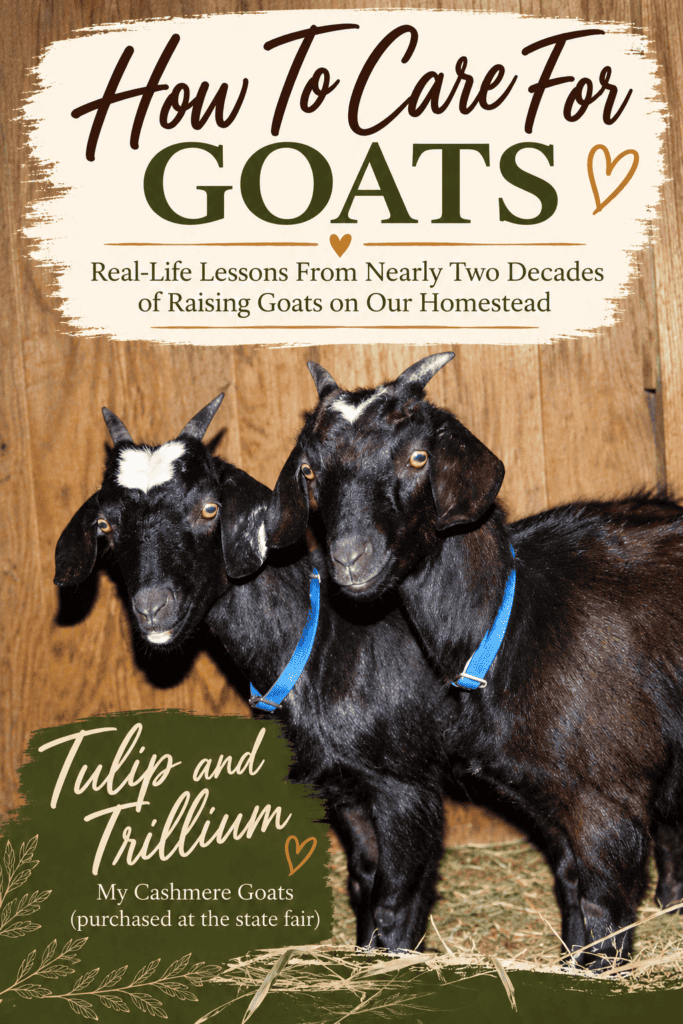
Fiber goats taught me another lesson that comes up over and over in goat keeping: the purpose and breed of the goat matter. I do disbud my dairy goats, but I did not disbud my fiber goats. Tulip was also a smaller goat, and although she lived here for a long time and was an excellent mother, I chose not to milk her. Just because a doe can potentially produce milk does not mean I need to turn every doe into a household milk goat.
Trillium, unfortunately, did not have the long life Tulip did. She came here sick with pneumonia and did not live very long. Pneumonia is something I have seen more than once in animals coming into the homestead, and those experiences are part of why I pay so much attention to quarantine, appetite, breathing and whether a new animal simply looks or acts wrong.
One thing that is probably different about the way I keep goats is that I do not look at my adult herd as animals that need to be replaced when their most productive years are over. I sell most of the babies, of course, but once I bring a goat here with the intention of keeping her, this is normally her home for life. There have been unusual exceptions over the years, but I do not routinely trade out older goats for younger ones. I am feeding and caring for the whole animal for her whole life, not just for the years when she can give me babies or put milk in the bucket.
Goat care is also much more than putting up a fence, tossing out some hay and filling a water trough. You learn the personalities, herd politics, appetites and habits of the animals you live with. Eventually you walk into the barn and know when something is not right before you can necessarily explain why.
Goats Need Other Goats
One of my earliest lessons was that goats are herd animals. After Eddy died, the next spring we brought home Darla, an Alpine/Nubian cross dairy goat that had recently freshened. Darla stood in the barn and yelled and yelled. She sounded so much like a distressed child that someone actually called CPS because they thought a child was being abused here.
I called a friend who raised goats and told her what was happening. Her response was basically, "You idiot, you can't have just one goat." She was right. We brought home a horned wether she sold us that we called Mr. Buck, and Darla settled down.
That experience changed the way I buy goats. Two is certainly better than one, but when I can, I prefer three. My thinking is practical: if you have only two and something happens to one, you suddenly have a single miserable goat while you are grieving and trying to figure out what to do next. I have had horses and sheep here, and the goats have gotten along with them. I have even known a single goat and a horse that were perfectly happy together. Still, after listening to Darla scream her head off, I am not deliberately planning a one-goat herd again.
Housing Goats and Managing the Barn
My goats live in the barn, and the setup has evolved around what I have actually needed over the years rather than what somebody's ideal barn diagram says I should have. We have four different stalls. One is our birthing stall. A doe goes there when she is getting close to kidding, and afterward it gives her and her babies private space to bond. We also have a very small stall that can be used to separate a buck when necessary or to quarantine an animal. And we have the large main stall plus a stall of equal size next to it for the poultry.
Straw is my usual bedding, especially in winter because I like the warmth it provides. I have used corn cob bedding and other materials over the years, and I liked corn cob bedding quite well. I also use products such as Stall Fresh, lime and diatomaceous earth on the stall floor before bedding. I am always interested in natural products that help me manage moisture, barn odors and flies, including some essential-oil-based barn products.
Winter is one of the places where I deliberately do not try to make the barn look freshly scrubbed every week. Winter barn management looks different from warm-weather cleaning. I add clean straw as needed through the cold months instead of stripping the stalls down to bare floors. Manure and old bedding build beneath the fresh layers, and that deep bedding helps provide warmth. We normally do a major cleanout after cold weather ends, around April or May, and another deep cleaning in August or September as we prepare for winter.
The deep bedding also works with one of those unavoidable goat habits: a fair amount of hay ends up on the floor no matter how much I would prefer it stay in the feeder. In winter that discarded hay becomes part of the bedding layers along with the straw I add, so I manage the stall with that reality in mind instead of pretending I can keep a goat stall spotless.
Fencing That Actually Holds Goats
If you are planning a goat fence, build it for the goats you are actually going to keep. A fence that looks perfectly adequate to us may look like a minor inconvenience to a determined goat. I have learned that lesson the aggravating way, and you really do not want to spend your day chasing goats around the property.
Our permanent fencing is six-foot chain link reinforced with farm fence posts roughly every two feet. We use metal conduit along the bottom on the inside, secured to the posts and chain link. In places we may add another bar at the top or through the center. What I have learned is that if a goat pushes on a fence and the fence does not give, eventually the goat tends to go find something easier to get into.
Hog panels did not work for us. Ferdinand simply climbed over them. Regular electric fencing has not been my favorite for goats either. What I do like for temporary, moveable fencing is my Premier1 DS PoultryNetPlus 12/48/3 Starter Kit. I use it when I want to move the goats around different areas of our 2.5 acres so they can browse without giving them access to the entire property. Once they learn that electric netting is on, they generally respect it instead of continually testing it.
What I Feed My Goats
Hay is the backbone of what I feed here, and this is one place where I am picky because seven goats can go through an astonishing amount of it. I buy square bales of an alfalfa and grass mix year-round from the same person. I know the quality I am getting, they deliver it, and I am not interested in gambling with moldy or questionable hay just to save a little money. With seven goats, we normally order 21 bales at a time and that lasts about 21 days, so figure roughly a bale a day disappearing around here.
And I do mean disappearing. Goats waste hay like they have unlimited access to my bank account. They pull perfectly good hay out of the feeder, drop it on the floor, step on it and then refuse to eat it. Some of that becomes bedding, but it is still something to account for when you are trying to estimate what keeping goats is actually going to cost.
During the growing season the goats also have pasture and browse. They eat weeds, brush and woody plants and try their best to reach trees. I only have 2.5 acres, so I am not growing huge dedicated forage fields, but I do work goat food into what I grow. They get stalks after we harvest our sweet corn, wheat remnants, pumpkins and other suitable crops. I have deliberately tried crops including buckwheat, tromboncino and mangel-wurzels. The mangel-wurzels were a failed crop for me. I did get tromboncino, and the goats ate it, although I think the poultry may have enjoyed it even more. I also occasionally offer fresh fodder in winter.
I currently feed Nature's Best organic pelleted goat grain because I can buy it locally at Tractor Supply. I prefer the organic goat grain from New Country Organics, but shipping has become expensive enough that I can no longer justify having it sent here regularly.
My adult goats are offered up to about two pounds of grain at a feeding, but most do not eat that much. I measure what is left and return the uneaten portion so I have a realistic idea of what each goat is consuming. Most of the adults eat closer to a pound to a pound and a half. A heavy-producing dairy doe such as Taboo needs considerably more nutrition than a goat that is simply maintaining herself. If I am asking a doe to put a lot of milk in my bucket, I have to feed her accordingly.
I also use black oil sunflower seeds along with kelp or goat mineral, and I keep loose mineral and mineral blocks available. Some supplements are offered free choice. I have used baking soda free choice at times when I am concerned about digestive upset. I also use products from Molly's Herbals, including products for udder care, herbal parasite-management products, fly concentrate and Mo' Milk.
Male goats deserve special nutritional attention because urinary calculi can be a serious problem. When Jackson first came here, his feed included ammonium chloride for that reason. I do not simply feed a young buck the same ration I feed a lactating doe. Your veterinarian and a knowledgeable goat-feed supplier can help you choose an appropriate ration for the age, sex and job of the goat you are feeding.
Water Matters Too
We use a 55-gallon Rubbermaid trough. It gets refilled regularly and dumped and scrubbed when needed. When I empty a trough for a thorough cleaning, I like being able to swap in another one so the cleaned trough can sit in the sunshine and dry. If it is not going immediately back into service, I may turn it upside down to help keep it clean.
I also use a barley-straw-filled burlap sack in the water as part of my natural approach to managing algae and water quality. At times I have added a splash of apple cider vinegar to the water as well. The important thing is that the goats have water available and that I actually look at the trough instead of assuming it is fine because I filled it yesterday.
My Daily Goat Check
After you have lived with goats for a while, the daily check stops feeling like a formal inspection. I walk into the barn and take everybody in. Who gets up? Who comes over? Who is yelling at me because breakfast is apparently six minutes late? Who is hanging back? That is the beginning of my health check, whether I consciously call it that or not. I look at ears, eyes and tails. I watch how they walk. I look around the ground for diarrhea or anything else unusual. When I put out hay, I make sure everybody wants to eat. When I refill water, I pay attention to whether they drink.
Standing off by herself is a big one for me. So is a goat that stays down, does not answer me, suddenly quits eating or just has that look that makes me stop what I am doing. It is hard to explain to somebody who has never kept livestock, but you really do learn your animals. Sometimes I cannot immediately point to a symptom and say, "There it is." I just know something is off. That is when I stay longer, look closer and decide whether I need to call the vet.
I also watch the way they interact because goats can be bullies. Herd hierarchy is real, and adding new animals can change the dynamics. This year I bent down to pick up Taboo's collar after it came off and Darla headbutted me in the head three times. I ended up with a concussion and a trip to the emergency room. It was very unusual behavior for her, but we had new goats and Darla is the head honcho. My best interpretation was that she had some strong opinions about the changing herd hierarchy.
Nobody told me what drama queens goats could be either. They can be loud, persistent and very much in your face. I swear some of them can scream "Mom!" well enough to fool a person who does not know there are goats in the barn.
Hoof Care
I trim my goats' hooves myself. For years I used inexpensive trimmers from the farm store and struggled with them. They did not hold up well, trimming became difficult, and at times I paid my veterinarian to do the job because my tools simply were not working for me.
The Premier1 Serrated Foot Trimmer made a tremendous difference. It was not cheap, but even with arthritis in my hands I can get through the hoof much more quickly and comfortably. I also use a hoof pick like the kind used to clean a horse's hoof to clean debris from the goat hoof before and during trimming.
There is not one trimming interval that fits every goat in my herd. Some hooves grow faster than others. I look at the hoof and the way the goat is walking rather than waiting for an arbitrary date on the calendar. Babies can be the hardest because some are not yet tame enough to cooperate and our stand is not ideal for very small kids, so I sometimes need another person to hold the kid while I work.
I also purchased a small cordless angle grinder after seeing one used to level a hoof that was difficult to get perfectly flat with trimmers. I have inspected the tool but have not needed to use it yet, so I cannot give a firsthand recommendation on it. It is simply another option I have available if I encounter the right situation.
Parasites, Fecal Testing and Knowing When Natural Management Is Not Enough
I prefer a natural approach to parasite management, but natural does not mean guessing and it certainly does not mean refusing conventional treatment when a goat needs it. I own a fecal-testing kit and do fecal checks, so I am looking for evidence instead of automatically deworming every goat on a calendar. Incoming goats are where I have most often seen parasite problems. Moving is stressful, and that stress can allow a parasite burden that was not obvious before the move to become a problem afterward. I do not automatically assume that means the previous owner neglected the goat. I watch the goat, check fecals and deal with what is actually in front of me.
I use diatomaceous earth and herbal products as part of my management, but if testing or the condition of the goat tells me that is not enough, I involve my veterinarian. I will use a conventional dewormer when that is what the goat needs. The welfare of the goat comes before my preference for a particular management style.
Why I Quarantine New Goats for 30 Days
I learned the importance of quarantine the hard way after dealing with CL early in my years of keeping goats. That experience permanently changed the way I bring a goat onto this homestead. Today a new goat spends 30 days quarantined across the barn near the chickens, physically separated from the established herd. They cannot touch noses and they do not share feed or water. Thirty days can feel like a long time when you are excited about a new goat, but I would much rather spend that month watching one animal closely than introduce a problem and suddenly have an entire herd to worry about.
I care for my established herd first and the quarantined goat last. After handling the quarantined animal, I come inside and wash up. I also keep rubbing alcohol in a sprayer for times when I need it for my hands or clothing. The incoming goat sees the veterinarian during quarantine, and if something concerns me, the goat is seen again before joining the herd.
Those 30 days give me time to slow down and really learn the new goat before I ask the rest of the herd to accept her. I can watch how she eats, drinks, walks and behaves, deal with any parasite or health problems that show up, and get a feel for what is normal for her. Yes, quarantine is inconvenient, especially when you are excited to introduce a new goat to the herd. After dealing with CL, though, I know exactly how much more difficult it is to deal with a contagious problem after the whole herd has been exposed. I will take the inconvenience of those 30 days.
Routine Veterinary Care and Knowing When to Call
My goats receive CD&T vaccination through my veterinarian, and we normally have an annual veterinary visit in the spring. New goats are also evaluated during quarantine. I am comfortable doing many routine jobs myself, but I am equally comfortable calling my vet.
Not eating, serious bloat, breathing trouble, neurological behavior, a goat that will not get up, a kid that will not nurse, a difficult kidding or anything that simply looks seriously wrong is reason for me to get veterinary advice. I have recognized pneumonia in goats that arrived here sick. Ferdinand and Jackson were treated and recovered. Eddy was already too sick when he arrived for us to save him.
A few years ago we also had a kid that seemed weak and wobbly. We contacted the vet and sent a video. After looking at it, the vet told us the kid would likely be okay by morning, but to keep monitoring her. She was. That experience reinforced something important for me: calling the veterinarian does not always mean there is a catastrophe. Sometimes it means getting another set of trained eyes on a situation, finding out what you need to watch for and knowing when it is reasonable to keep monitoring at home.
The Goat Supplies I Like to Keep on Hand
If you are expecting me to tell you I have one beautifully organized, Pinterest-worthy goat emergency kit, I don't. My goat supplies have accumulated over the years into a couple of toolboxes because when you need something for a goat at 2 a.m., that is a terrible time to discover you do not own it. I keep things such as towels, pet or baby wipes, Blu-Kote, baking soda, oral dosing syringes, goat nipples and clean 16-ounce plastic bottles that can be fitted with those nipples for bottle feeding. I also keep an infant feeder that I originally bought when we were desperately trying to get nutrition into Eddy.
I keep dog diapers too. Most of the time my veterinarian comes here, but sometimes an animal needs to go to the clinic immediately. A diaper makes transporting a goat in a vehicle a whole lot less messy. I retain veterinarian-prescribed medication until it expires so that if I call about a future problem and the veterinarian says I can use something I already have, I can tell them exactly what is on hand rather than dosing an animal on my own.
Breeding and Pregnancy on My Homestead
I normally breed my eligible does each year. A young doe may breed in the fall of the year she is born if I believe she is large and mature enough, but I am not going to breed a small doeling simply because the calendar says breeding season has arrived. If I am not comfortable with her development, she waits until the following fall.
My buck normally lives with the does, so my breeding program is probably going to look very relaxed to somebody who keeps a calendar full of exact breeding dates and pregnancy-test results. I generally do neither. I watch my goats. As pregnancy progresses and kidding gets closer, changes in the doe, her body and especially her udder become increasingly obvious. After you have watched enough does go through it, you learn what you are looking at. When I believe she is getting close, she moves into the birthing stall where I can watch her more closely and she has a quieter place to deliver and bond with her babies.
I separate the buck around kidding time because I want the doe and her babies to have their own space. I want mama focused on her kids and the kids able to bond and learn to nurse without the entire herd crowding them.
Kidding, Colostrum and the First 24 Hours
If there is one thing I want a new goat owner to take away from this section, it is this: colostrum matters, and those first 24 hours matter. A lot. I prefer babies to stay with mama, and with a healthy doe and kid I want to give them room to do what comes naturally. Mama cleans the baby, talks to it, and the kid starts trying to get those wobbly little legs underneath itself. I am watching, though. I want to see that baby get up, find a teat and actually nurse. I do not assume that because the kid is standing beside mama everything is fine.
If the kid does not nurse, I start figuring out why. Sometimes the kid needs help finding the teat. Sometimes a first freshener needs help understanding that she is supposed to stand still and let that baby eat. I will put mama on the milk stand and help the kid nurse there if necessary. If that does not work, I can milk the doe and bottle-feed the kid.
Sometimes the problem is mama rather than the baby. I once had a doe that simply was not a good mother. She produced beautiful babies but would not reliably let them nurse. I eventually placed her as a pet and was very clear with the new owners that I would not breed her again. Bailey, on the other hand, once refused to let Ferdinand nurse, but Ferdinand was not her kid. I bottle-raised him, and Bailey has since proven to be a fabulous mother to her own babies.
If a kid needs much closer monitoring, I can bring it into the house. I have an old antique wooden playpen that I set up indoors, diaper the kid and keep it where I can watch it. I have done this with sick or cold kids. A healthy goat kid belongs with mama when possible, but when I need to know whether a baby is getting warmer, stronger and eating, having that baby close enough to monitor can be invaluable.
I have not been present for every birth. Sometimes I am there and sometimes the doe handles everything before I arrive. We added barn cameras, which make it much easier to watch without constantly disturbing the doe. When Taboo kidded Belle, I was watching very closely because Taboo was my first registered show goat and I was tremendously invested in that birth. I saw what looked like a lot of blood and thought she was struggling. Jeff helped pull Belle and we called the veterinarian. Looking back, having a camera on every moment probably made the process feel even more intense, but when I believe something is wrong, I would rather make the call than ignore my instincts.
Disbudding and Castration
With my dairy kids, I disbud, and male kids that are not going to remain bucks are castrated. That is not a blanket rule I have applied to every goat I have ever owned. When I kept Angora and Cashmere goats for fiber, I did not disbud those goats. Purpose and breed matter, and this is one of those places where I think it is important to know what kind of goat you are raising instead of assuming every management decision is identical.
I normally have my veterinarian handle the disbudding, and these days I usually have the vet place the castration bands too. I have banded goats myself, so this is not about believing I am incapable of doing it. It is more practical than that. If the veterinarian is already here examining the kids, giving CD&T vaccinations and disbudding, I am perfectly happy to pay him to put the bands on while he is here. Homesteading does not mean I have to personally do every single job just because I technically can.
My early experience with Mr. Buck also taught me how destructive horns can be in the wrong situation. He put holes in the barn walls and became such a problem that he was one of the rare goats I rehomed. He went to someone who wanted to get into goats and had a good life, but he certainly taught me a lesson.
Dairy Goats and Milking Are Another Layer of Care
If you keep dairy goats, feeding and caring for the doe is only half the job. Milking introduces sanitation, milk handling, cream separation, cheesemaking, storage and a whole second set of routines. I have been milking dairy goats since 2006, and I recently rebuilt my complete Ultimate Guide to Goat Milk for the Modern Family around what I actually do from the milk stand through the kitchen.
That is really the thread running through everything I do with goats: I manage the goat standing in front of me, not an imaginary average goat from a chart. One doe may need more feed because she is putting two or three pounds of milk in the bucket twice a day. Another may leave half her grain behind. One first freshener may stand beautifully while another dances all over the milk stand. One baby may be up nursing before I have time to worry, while another needs me to put it directly on the teat. The books, charts and recommendations give you a place to start. Your own goats teach you the rest.
And if one of the reasons you are learning to care for goats is because you want fresh milk for your family, the care does not stop when the milk hits the bucket. Clean handling, chilling, storing and actually using all that milk become their own set of homestead skills. I put the milk side of the process into a free 41-page guide so you can take the next step from caring for the goat to making good use of what she produces.

Get my free 41-page guide, From the Milking Stand to the Kitchen, with practical help for handling, storing, preserving and using fresh goat milk at home.
Free download • Delivered by email • No purchase required
What Nearly Two Decades of Goats Have Taught Me
Almost everything I know about goats has a face and a story attached to it. Eddy taught me how quickly a goat can steal your heart. Darla taught me that one goat can sound enough like a screaming child to bring CPS to your door, and years later she also taught me not to put my head in the wrong place when the herd hierarchy is changing. Mr. Buck taught me what horns can do to a barn wall. Ferdinand taught me that a hog panel is apparently just a climbing challenge. Bailey taught me that a doe can refuse one baby and later turn out to be a wonderful mother. Taboo has taught me what a truly productive dairy doe can do when she has the genetics and nutrition to support it.
That is the part of keeping goats I do not think a basic care chart can give you. They are funny, frustrating, destructive, affectionate, loud, dramatic and incredibly individual animals. They will make you laugh, scare you half to death, waste hay you just paid for, climb something you were certain no goat could climb and occasionally send you to the emergency room. Then they will come running when you call their names and remind you exactly why you keep them.
If you are new to goats and something in this guide leaves you wondering how it works in real life, leave your question in the comments. There is a good chance I have either dealt with it sometime during the past two decades or know exactly which question I need to take to my veterinarian.
More Goat Care, Goat Milk and Homestead Dairy Resources
The collection below brings together more of my goat-care, kidding, hoof-care, milk-handling, dairy and goat-milk recipe articles. Use this guide as your starting point, then dig into the individual topics when you need the step-by-step details.
Caring For Goat Kids
What I watch for with newborn kids, feeding, bonding and those important first days.
Goat Hoof Trimming Guide
A closer look at keeping goat hooves trimmed and the tools that make the job easier.
DIY Goat Milk Stand
A practical milk stand makes routine milking, hoof care and handling much easier.
Ultimate Guide To Goat Milk
Follow the milk from the barn into the kitchen, including handling, storage and ways to use it.
Homemade Goat Teat Dip
The homemade teat-care recipe I use as part of my milking routine.
Homemade Udder Balm
My udder-balm recipe and how it fits into hands-on dairy-goat care.