Gurin Dehumidifier Review: My Experience, Features and Limitations
Disclaimer: I received this item for free in exchange for my honest review. All opinions are my own.
Have you ever opened the box on a new appliance and discovered that the information on the packaging didn't match what you thought you were buying? That's what happened when I received the Gurin dehumidifier to review. The Amazon listing advertised coverage for 1,100 cubic feet, but the numbers on the box suggested a much smaller area. Since I was hoping to use it in our damp basement, that difference mattered. I wanted to know which number was right before I could give it a fair review.
What surprised me most was that my original concern wasn't about whether the dehumidifier worked. It was about knowing what size space it could realistically handle. The company eventually answered my question, and the Gurin is still working years later. Our basement, on the other hand, turned out to need a much bigger solution. That experience changed how I look at compact dehumidifiers and where I would use one around the homestead.

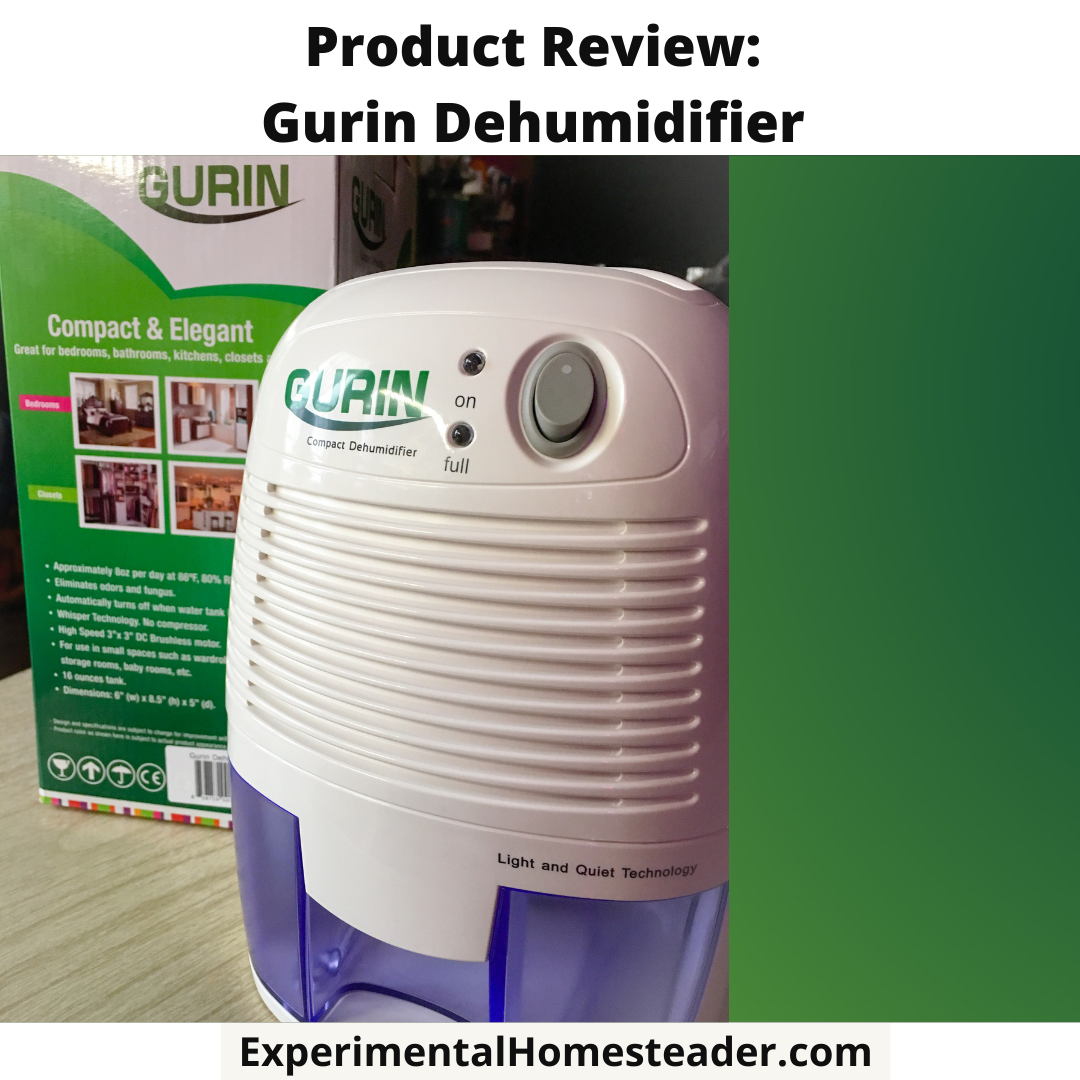
When I read this description I was expecting an 1100 cubic foot dehumidifier. What I got was one that looks like this one but only does a little over 500 cubic feet. Since I needed this for my basement, it makes a difference - and this one is not big enough.
I emailed the seller asking why the listing on Amazon said 1100 cubic feet and the box gave measurements that equaled a little over 500 cubic feet - no reply - and today is the day I need to get this review done - so. There was nothing in the actual instructions as to the cubic feet it could handle.
The company eventually responded and explained that the coverage information on the box was incorrect. I was glad to get that clarification because the discrepancy mattered to me: someone buying a dehumidifier needs to know whether it can handle the room where they intend to use it. I had originally given the Gurin dehumidifier three stars because of the conflicting information and the lack of a response when I first contacted the seller. Once they answered my question, I raised the rating to five stars. The change wasn't because the machine suddenly worked differently; it was because the company had addressed the concern that affected my original review.
In everyday use, I liked the Gurin. It was quiet, simple to operate, and looked nice enough to leave out where people could see it. The automatic shutoff was a useful feature because the machine stopped when its reservoir was full. What I didn't like was having to empty that reservoir by hand. There was no automatic drainage on this model, and that meant checking the tank and emptying it whenever necessary. For a small room or storage closet you visit regularly, that may be perfectly manageable. For the basement I was trying to deal with, I knew it would become a nuisance, especially when I had so many other things to keep up with around the homestead.
In This Article
The Coverage Confusion That Changed My First Impression
The listing advertised coverage of 1,100 cubic feet, while the measurements on the packaging suggested a little over 500 cubic feet. I looked through the instructions hoping to find a clear explanation, but there was nothing that settled the question. I wasn't trying to be difficult about the numbers. If you're buying an appliance to handle moisture in a particular room, the amount of space it is designed for is one of the first things you need to know. I contacted the seller rather than guessing which figure was right.
The seller's eventual reply resolved my question about the packaging, but it didn't change the practical issue I was facing. A coverage claim is only one part of choosing a dehumidifier. A small appliance may be quite capable of collecting moisture in an enclosed closet without being sufficient for an entire basement, particularly one with ongoing moisture problems. That distinction became even more important as we dealt with the condition of our own basement over time.

What I Liked - and What Would Give Me Pause
What makes this Gurin dehumidifier pleasant to use is its size and quiet operation. You don't need a complicated setup to use it, and it doesn't look out of place in a room. I appreciated those details when I first reviewed it, and I still do. Of course, those conveniences don't tell you how much moisture it can remove, which is why I think it's important to look at the actual capacity rather than judging a dehumidifier by how nice it looks or how little noise it makes.
There is also a practical difference between a unit you can check while going about your daily chores and one you expect to run in a basement without much attention. The Gurin requires someone to empty the reservoir when it fills. If you're using it in a small storage area, you can make checking the tank part of your normal routine. That wasn't the arrangement I wanted for a much larger basement, and it is something I would consider carefully before choosing this type of machine.
How Much Moisture Can a Compact Dehumidifier Remove?
One detail worth paying attention to is how much water the machine can actually collect. The original packaging lists approximately eight ounces of water removal per day at 86°F and 80% relative humidity, with a 16-ounce reservoir. Eight ounces is one cup. That is quite a different scale from the pints-per-day ratings you see on many larger basement dehumidifiers. These are figures printed on the packaging, not measurements I made in a controlled test.
Also notice the conditions attached to that number: 86°F and 80% relative humidity. Your closet or basement might be cooler or less humid, and the amount of water collected can change. A thermoelectric unit like this is small and quiet, but it generally removes much less water than a larger compressor-style machine. Seeing water in the tank tells you it is collecting moisture; it doesn't tell you by itself whether the humidity in the room is where you want it.
There's another number that can be confusing: the 16-ounce tank is not a promise that the machine removes 16 ounces of water every day. It is simply the amount the reservoir holds. When that tank fills, the automatic shutoff stops the unit until someone empties it. I liked having that feature, but I didn't want another regular chore just to keep our basement dry. In a small storage closet that I can check often, emptying the tank would be much easier to manage.
What Changed in Our Basement - and Why I Still Have the Gurin
There's another chapter to this story that I couldn't have included in my original review. We eventually had extensive work done on our basement walls by Indiana Foundation. After that work, I went with a whole-house commercial dehumidifier. I needed a system suited to a much larger area, not a small machine that I would have to keep checking and emptying. Those were two very different jobs, and I don't want anyone reading this older review to think the Gurin dehumidifier is what I rely on for the basement today.
I kept the Gurin because it still works. There is something satisfying about finding a sensible use for equipment you already own instead of replacing it just because your original plans changed. I haven't tested it in a food-storage closet, but that's one smaller space I would consider for it. The question would be whether that particular closet has excess moisture the Gurin can realistically remove, not simply whether the machine fits on a shelf.
Would I Use a Small Dehumidifier in a Food Storage Closet?
Before placing any dehumidifier near stored food, I would think about what is actually in the closet. Sealed canning jars, dry goods, and cardboard packages aren't the same as freshly harvested potatoes or other produce. Potatoes generally need cool, dark conditions and relatively high humidity, while excess dampness can cause trouble for cardboard packaging and shelving. I'd rather choose the conditions for the food first and then decide whether a dehumidifier belongs in that space at all.
If the closet felt damp, I'd start by checking the actual humidity with a hygrometer and looking for the reason. Is the problem seasonal humidity? Is air trapped behind tightly packed shelves? Is water getting in somewhere? A dehumidifier can remove moisture from air, but it cannot repair a leak or fix a wall that is allowing water through. Having gone through major basement work myself, I wouldn't confuse those two jobs.
If I did try the Gurin in a storage closet, I would compare humidity readings before and after using it. Water in the reservoir would show that the machine was collecting moisture, but it wouldn't tell me whether the closet was staying at an appropriate humidity for the food stored there. That's the result I would care about, rather than simply seeing the appliance run.
If you're planning food storage, also read my guides to factors that affect food storage and storing potatoes. They explain why there isn't one perfect humidity level for every kind of food you might put away.
For more ideas about organizing what you preserve, see my home food storage solutions, prepper pantry ideas, and home food preservation methods. Those projects are about making the most of the food you put away, while this review is about deciding whether a compact appliance belongs in the space where you keep it.
What I'd Check Before Buying One Today
The first question I would ask is how much water the machine needs to remove, not simply how large the room is. A coverage figure can sound impressive, but it doesn't tell you whether a compact appliance will keep up with persistent dampness. I'd want to know the room's actual humidity and how the manufacturer's moisture-removal rating was measured before relying on a unit for ongoing use.
I would also think about how often I actually visit the room. The Gurin's automatic shutoff is useful, but once the reservoir is full, the machine won't collect more water until someone empties it. That routine may be easy to manage in a closet near the kitchen and far less practical in an out-of-the-way basement. It's a small detail when you're shopping, but it makes a difference once you're living with the appliance.

Is the Original Gurin Dehumidifier Still Available?
One thing I want to make clear for anyone shopping after reading this review is that the Amazon link may now show a newer Gurin model. My experience, photographs, and video are about the original dehumidifier I received. I haven't tested a replacement, so I can't tell you whether a newer version runs the same way, has the same reservoir, or performs any better. If you're considering one today, check the current model number and specifications rather than assuming the product in the listing is identical to mine.
Would I Choose This Gurin Dehumidifier Again?
Yes, I would consider another compact dehumidifier for the right space, and I'm glad I gave this Gurin a fair chance after the company answered my question. It has continued to work, which says more to me than a list of selling points. I wouldn't choose it for the basement we were dealing with, but that doesn't make it a poor appliance. It simply means I now have a better understanding of what I need from a dehumidifier before I buy one.
Have you tried a small dehumidifier in a pantry, storage room, closet, or basement? I'd be interested to know whether it kept up with the moisture and how often you ended up emptying the tank. Those real-life details can be far more useful than the numbers on the front of a box.
Build Your Pantry a Little at a Time
Thinking about a food storage closet often leads to a bigger question: what should you keep in it? You don't have to buy a year's worth of supplies all at once to make progress. My free 52 Week Stocking Up List gives you a way to build your household supplies gradually, one week at a time. It's especially helpful if you want to be better prepared but need to work within a grocery budget, or if you've been putting off stocking up because the whole project feels overwhelming. You can find it on my free downloads page along with other homesteading and preparedness resources.
Keep Learning With Experimental Homesteader
If you enjoy practical, firsthand information about food storage, preserving the harvest, homesteading, and being better prepared for whatever comes along, I'd love to have you join my email list. It's a way to stay connected with what I'm sharing on Experimental Homesteader instead of having to remember to check the website for every new article or resource. I share the projects, ideas, and lessons that come from actually doing these things, including what worked, what didn't, and what I'd do differently. You can sign up below, and if you're working on your pantry, be sure to pick up the free 52 Week Stocking Up List, too.