
How To Use And Separate Goat Milk Heavy Cream
If you are looking for goat milk heavy cream, you might be wondering why you don't see a thick layer of cream sitting on top of your fresh goat milk the way you might expect with fresh cow milk.
Goat milk does contain cream.
The difference is that the smaller fat globules in goat milk tend to stay suspended in the milk instead of quickly rising to the top.
That is one of the reasons goat milk naturally looks so smooth and creamy, but it also means separating enough goat milk heavy cream for butter, whipped cream, ice cream, and other recipes can take a little more work.
I have separated cream from our goat milk by simply letting the milk sit in the refrigerator and skimming the cream off the top.
It works, especially when you only need a small amount of cream, but it is not nearly as efficient as using a cream separator.
The good news is you don't necessarily need special equipment to get started.

In This Article
Can You Get Heavy Cream From Goat Milk?
Yes, you can get heavy cream from goat milk, but don't expect to open the refrigerator the next morning and find a huge layer of cream sitting on top of the jar.
Sometimes I get a nice layer that is easy to scoop off and other times there isn't nearly as much as I would like, especially if I am trying to save enough cream to make butter or ice cream.
How much cream you get is also going to depend on your goat.
Some goats simply give richer milk than others, and the amount of cream you get can change throughout the lactation season.
This is one reason I save the cream even when I only get a small amount.
A few spoonfuls might not seem like much, but I can freeze it and keep adding to it until I have enough for whatever I want to make.
That's also when a cream separator starts to make a lot of sense.
If you regularly want goat milk heavy cream instead of just occasionally skimming a little off the top, you're going to get a lot more of it with a separator than you will with a spoon.

Is A Cream Separator Worth It For Goat Milk?
For years, I skimmed the cream off the top of my goat milk with a spoon.
It worked, and if that is what you have available, there is absolutely nothing wrong with doing it that way.
The problem was I never seemed to collect as much cream as I actually needed.
Buying a cream separator changed that for me.
I was really surprised by how much more cream I was able to get from the same milk once I started using one.
I knew I was leaving cream behind when I skimmed it by hand, but I don't think I realized just how much until I saw the difference for myself.
That matters in my kitchen because I actually use the cream.
I make goat milk butter, homemade ice cream, whipped cream and other recipes that call for heavy cream.
Before buying the separator, I frequently ended up adding store-bought heavy cream to what I had collected from my goats just to have enough for a recipe.
I still buy heavy cream occasionally, but I don't need to buy nearly as much as I used to.
For me, that is where the value of the cream separator really comes in.
It isn't just another piece of equipment sitting around my kitchen.
I'm getting more usable cream from milk I already have, and that means I can make more of the things I want to make using the milk my own goats are producing.
If you're only interested in collecting a little cream now and then, skimming it with a spoon may be all you need.
But if you're milking regularly and actually want to use your goat milk cream, I have found a cream separator makes a huge difference.

Get my free 41-page guide, From the Milking Stand to the Kitchen, with practical help for handling, storing, preserving and using fresh goat milk at home.
Free download • Delivered by email • No purchase required
What Does Goat Milk Heavy Cream Look Like?
When I let fresh goat milk sit in a clear glass jar in the refrigerator, the cream that rises to the top isn't always as obvious as you might expect.
Sometimes there is a pretty noticeable layer, but other times I have to look closely at the side of the jar to see where the cream ends and the milk begins.
The cream is usually a slightly different shade of white and looks thicker than the milk underneath it.
This is one reason I prefer using clear glass mason jars.
I can actually see the cream line before I start trying to remove it.
Once I scoop the cream off with a spoon, it is often thick and a little gloppy.
The first time you see that texture, especially if you are used to pouring heavy cream out of a carton from the grocery store, you might wonder if something is wrong with it.
Fresh goat milk cream doesn't necessarily look or pour exactly like commercial heavy cream.
You may also scoop up a little milk along with the cream, especially when you get close to the bottom of the cream layer.
I don't worry about getting every spoonful perfectly separated.
If I am saving the cream for butter, ice cream or another recipe, a little milk mixed in isn't going to bother me.
What I do pay attention to is anything that seems genuinely unusual.
If the milk or cream has an off odor, unexpected discoloration or other signs of spoilage, that's different.
But thick, somewhat gloppy cream sitting at the top of otherwise properly handled goat milk is normal in my experience.
And honestly, once you've skimmed it a few times, you get pretty good at spotting that cream line through the side of the jar.

How To Separate Goat Milk Heavy Cream Without A Cream Separator
You can separate goat milk heavy cream without a cream separator, although you won't recover as much cream as you would with a machine.
After milking, strain and handle your goat milk according to your normal milk-safety routine.
I pasteurize the goat milk we use in our kitchen, and you can read my complete tutorial on how to pasteurize goat milk at home.
Then place the milk in a clean, clear glass container and refrigerate it.
I like glass because I can actually see what is happening inside the jar.
Allow the milk to sit undisturbed overnight.
Sometimes I leave mine from the morning milking until the evening milking before checking it.
Look closely at the top of the milk for a thicker cream layer.
Use a clean metal spoon to gently scoop the cream from the surface and transfer it into a separate clean container.
Don't worry if you get a little milk along with the cream.
That happens when you skim cream by hand.
You also won't remove every bit of butterfat this way.
Some will remain suspended in the goat milk, which is perfectly fine.
How Long Does It Take Cream To Rise On Goat Milk?
Give goat milk at least several hours in the refrigerator before checking for a cream line.
Overnight is even better.
I have found that this isn't something you can rush.
If I check the milk too soon, there may be very little visible cream on top, even though more will eventually rise if I leave the jar alone in the refrigerator.
When I am waiting for the cream to rise, I try not to disturb the milk unnecessarily.
Every time you pick up the jar, pour some milk out or move it around, you are mixing things back together.
If I know I want to skim the cream, I would rather leave that particular jar alone until I am ready to do it.
You may also notice additional cream collecting at the top after you have already skimmed the milk once.
I have seen this happen with my own goat milk.
I will remove what I can see, put the milk back into the refrigerator and then find another small layer on top later.
If that happens, I simply skim it again before I use the milk.
The size of the container can make a difference in how easy the cream is to collect as well.
A wider container gives you more surface area to work with, while a narrow jar can make a small amount of cream more difficult to skim without taking quite a bit of milk along with it.
I tend to use wide mouth pint sized canning jars because they are convenient for me, but it is worth experimenting with different containers if your main goal is collecting cream.
Keep in mind that waiting longer doesn't guarantee that every bit of cream is eventually going to appear at the top.
There comes a point when waiting another day isn't really gaining you enough to make it worthwhile.
And I definitely wouldn't leave milk sitting indefinitely just because I was hoping to get a little more cream.
Proper refrigeration and storage still matter.
If you are unsure how long to keep your milk, I have a separate guide explaining how long pasteurized goat milk lasts in the refrigerator.
For me, overnight is a good starting point.
Check the cream line, skim what is there and don't worry if you don't get every last bit.

Using A Cream Separator For Goat Milk Heavy Cream
I use a VEVOR cream separator for our goat milk, and I love it.
I get considerably more cream than I ever did when I relied on letting the cream rise and skimming it off with a spoon.
However, I also think anyone considering buying a cream separator should know what using one actually involves because there is more to it than pouring warm milk into the top and watching cream come out.
The VEVOR has a milk pot on top that holds the milk, along with a switch core, sometimes referred to as the metal rod, that controls the flow of milk into the separator.
There is also a buoy or float and funnel seat that help control and direct the milk as it enters the separating bowl.
Then there are the two outlets.
One is the cream outlet and the other is the skim milk outlet, so before I start, I need containers positioned under both to catch the cream and milk that comes out.
That is the simple part.
The separating bowl is where things get a little more interesting.
What's Inside A VEVOR Cream Separator?
Inside the separating bowl are a number of separating pieces or discs.
These are stacked together inside the bowl, along with the separating bowl base, sealing ring, separating cover and copper nut that holds the assembly together.
Those discs are part of what makes the separator work so well, but they are also one of the reasons cleanup takes some time.
When I am done separating milk, I don't just rinse out the milk pot and the two spouts.
I take the separating bowl apart.
And when I say take it apart, I mean take it apart.
The copper nut comes off, the separating cover comes off and all those separating discs have to come out so I can wash between them.
This is where I find that sticky, globby milk residue.
Milk gets down inside the separating bowl and onto those individual discs.
If you have ever had milk dry onto something, you already know I don't want to leave that residue sitting there until later.
Cleaning The Separating Discs Takes Time
This is probably the biggest thing I wish people talked about when recommending cream separators.
There are quite a few separating discs, and I want every one of them clean before I put the machine back together.
I remove them, wash the milk residue from them and make sure I don't have anything hiding between the discs or around the separating bowl.
The sealing ring needs cleaned too, as does the groove it sits in.
Then there is the separating bowl base, separating cover, cream outlet, skim milk outlet, funnel and the other parts that have come into contact with the milk.
It isn't hard work, but it isn't a two-minute rinse either.
It takes me about half an hour to completely clean all the parts of my machine and I do it by hand washing as my particular machine does not say if it is dishwasher safe.
And personally, I don't want to cut corners when I'm dealing with dairy equipment.
If fresh goat milk is going through it the next time I use it, I want to know there isn't old milk residue hiding inside.
Putting The Separating Bowl Back Together Matters
The other thing to know is that you can't just toss all those clean separating discs back into the bowl any way you please.
On my VEVOR, there is a special disc with a bump that belongs at the bottom.
There are also holes that need to line up correctly with the fixed pin on the separating bowl base.
The sealing ring has to be properly seated in its groove, and the separating cover and copper nut have to go back on correctly.
This is one of those jobs that seems like a lot the first couple of times you do it.
Once you've taken the separator apart, washed it and reassembled it enough times, you get to know the pieces and it becomes part of the routine.
Still, I recommend keeping the manual handy, especially in the beginning.
If you take everything apart and then can't remember which disc went where, that is not the time you want to start guessing.
I Clean Mine As Soon As I'm Finished
I don't like letting my cream separator sit dirty after I use it.
That residue inside the separating bowl is already sticky and globby when it is fresh. I certainly don't want to give it time to dry onto the separating discs.
So for me, running the cream separator means planning enough time to finish the entire job.
I need time to set it up, separate the milk, take the machine apart, wash all the milk-contact parts, let everything dry and put it back together.
That is something worth considering if you are imagining running a tiny amount of milk through the separator every morning and evening.
Just because the machine can separate the milk quickly doesn't mean the entire job is quick.
You Also Have To Think About Milk Temperature
Another thing I learned with my VEVOR is that the milk can't simply come straight out of my refrigerator and go into the machine.
VEVOR recommends fresh milk heated to approximately 95°F to 113°F (35°C to 45°C) for separation.
The instructions also call for running warm water through the machine before introducing the milk.
That adds another step because I need to run the goat milk through my machine as soon as I am done pasteurizing it, then I can start the chilling process.
This is another reason I like to think ahead about when I am going to run the separator rather than automatically running it every time I milk my goats.
Have Both Containers Ready Before You Start
This sounds incredibly obvious until the first time you have milk coming out of two different places at the same time.
You need something under the cream outlet and something under the skim milk outlet before you start letting milk into the separating bowl.
And I want those containers positioned where they aren't going to move around or get bumped while the separator is running.
Believe me when I say having the cream and milk run all over your countertops and on the floor is not fun.
I also make sure I have everything I need before I start because once the milk is flowing, I don't want to suddenly realize the container catching the skim milk isn't large enough.
Cream is the part I'm excited about, but there is considerably more skim milk is coming out of the other side.
The Cream Thickness Can Be Adjusted
Another interesting feature of the VEVOR is that the thickness of the cream can actually be adjusted.
There is an adjustment screw inside the separating assembly that changes the cream concentration.
According to the VEVOR instructions, turning the adjustment one direction produces thinner cream and the other produces thicker cream.
This is something I would approach in small adjustments rather than turning the screw dramatically and hoping for the best.
It also means taking the machine apart to make the adjustment, putting it back together and seeing what you get.
Once I find a setting that gives me the kind of cream I want, I don't see any reason to constantly mess with it.
Is A Cream Separator More Work?
Yes.
I don't want to tell someone to buy one without saying that.
There are days when washing the milk pot, funnel, outlets, separating bowl, sealing ring and that stack of separating discs is the last thing I feel like doing.
But there is another side to that.
I can actually see how much more cream I'm getting.
That is what makes the extra work worth it to me.
Before I had my VEVOR cream separator, I regularly had to buy heavy cream to supplement the small amount I was able to skim from my goat milk.
I still occasionally need purchased cream, but not nearly as often.
So yes, my cream separator means more dishes.
It means taking apart a separating bowl full of discs.
It means dealing with sticky milk residue and making sure everything is clean, dry and put back together correctly.
But it also means I'm getting more of the cream my goats produced in the first place.
I'll wash the discs.
How Much Heavy Cream Can You Get From Goat Milk?
There isn't one reliable answer because goat milk isn't identical from one animal to another.
The amount of heavy cream you get from goat milk depends on factors such as:
- Goat breed
- Individual genetics
- Butterfat percentage
- Diet and nutrition
- Stage of lactation
- Time of year
- Whether you skim by hand or use a cream separator
Some dairy breeds and individual goats naturally produce richer milk than others.
This is also why I wouldn't panic if someone else says they get far more cream from a gallon of goat milk than you do.
Unless you are milking the same goat under the same conditions, it isn't necessarily a meaningful comparison.
My Method For Skimming Goat Milk Cream
I like to chill my goat milk in pint canning jars filled no more than about halfway after I pasteurize my goat milk.
Yes, that means I get a thinner layer of cream on each individual jar.
It probably isn't the most efficient method if your only goal is collecting as much cream as possible.
It is simply the method that works well for me and the way I handle our milk.
If your main goal is cream collection, experimenting with a larger container may make the cream line easier to see and skim.
The important thing is to use clean containers, refrigerate the milk promptly, and give it time to sit undisturbed.
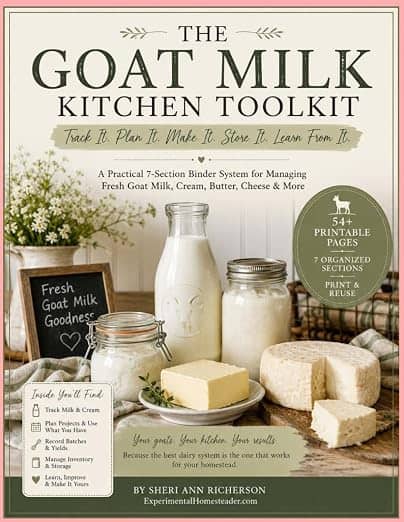
The Goat Milk Kitchen Toolkit
Track what your goats actually produce, record dairy batches, organize milk and cream, manage refrigerator and freezer inventory, plan what to make next, and build your own dairy reference system.

Printable Digital Edition
54+ printable pages. Print the working pages you need again and again for your personal homestead.
Instant digital download
Paperback Edition
Keep a permanent physical master copy in your dairy kitchen and get access to the printable working files for personal use.
Paperback includes access to printable working files
Choose the format that works best for your dairy kitchen. The printable edition is an instant digital download. The paperback is sold separately through Amazon and includes access to the printable working files.
What Can You Do With Goat Milk Heavy Cream?
Once you start collecting goat milk heavy cream, you have quite a few options.
Make Goat Milk Butter
One of my favorite uses is homemade butter.
Making butter is also one of those projects that really shows you just how much cream it takes to produce a relatively small amount of finished butter.
If you are ready to try it, follow my goat milk butter recipe.
Make Homemade Ice Cream
Cream adds richness and that wonderful mouthfeel we expect from homemade ice cream.
My chocolate ice cream recipe uses milk and heavy cream together.
If you don't collect enough goat milk cream for the recipe, you can combine the cream you've saved with purchased heavy cream.
I would much rather use the cream I have than waste it simply because I don't have enough for the entire recipe.
Make Whipped Cream
If your separated cream has a high enough butterfat content, you can use it to make homemade whipped cream.
This is one area where the actual fat content matters.
Cream skimmed by hand can contain more milk and may not always whip as easily or become as stiff as commercial heavy whipping cream.
Cream from a properly adjusted separator generally gives you much more control over how rich your cream is.
You can see how I make homemade whipped cream here.
Use It In Cooking And Baking
Goat milk cream can also be used anywhere you want additional richness.
Depending on the recipe and the fat content of your cream, try it in:
- Cream sauces
- Soups
- Custards
- Puddings
- Homemade caramels
- Mashed potatoes
- Biscuits and scones
- Coffee
- Hot chocolate
- Creamy desserts
Just remember that home-separated goat milk cream doesn't necessarily have the exact standardized fat percentage of the carton labeled "heavy cream" at the grocery store.
For most everyday homestead cooking that isn't a problem.
For recipes where the exact fat percentage is important, you may need to adjust or supplement it with commercial heavy cream.
Can You Freeze Goat Milk Heavy Cream?
Yes.
Freezing is one of the easiest solutions when you don't get enough cream from each milking to immediately make something with it.
This is especially useful when you are saving cream for homemade butter.
Put the cream into a freezer-safe container, leave appropriate room for expansion, label it with the date, and freeze it.
I use the same basic principles I use when freezing goat milk.
The texture may change somewhat after freezing and thawing, so frozen cream may not be my first choice when I need beautifully whipped cream.
For butter, ice cream, sauces, baking, and many other recipes, however, freezing small amounts until you have enough can be very practical.
Why Am I Not Getting Cream From My Goat Milk?
If you have refrigerated your goat milk overnight and don't see much cream, don't automatically assume something is wrong.
There are several possible reasons.
The cream hasn't had enough time to rise. Goat milk separates slowly. Give it more time while keeping it properly refrigerated.
The cream line is difficult to see. Try using a clear glass container and looking at the milk from the side in good light.
Your goat's milk has a lower butterfat percentage. Butterfat varies by breed, genetics, diet, season, and stage of lactation.
Much of the fat is still suspended in the milk. This is normal with goat milk and is exactly why cream separators are so useful.
You are expecting it to behave like cow milk. This is probably one of the biggest surprises for people who are new to dairy goats. Goat milk simply doesn't separate as readily by gravity.
Is Goat Milk Heavy Cream The Same As Store-Bought Heavy Cream?
Not necessarily.
In the United States, commercial products labeled heavy cream or heavy whipping cream have a standardized minimum milk-fat content.
The cream you skim from your own goat milk hasn't been standardized.
Its fat percentage can vary considerably.
That doesn't make homemade goat milk cream inferior.
It simply means you need to understand what you are working with.
For butter and many homestead recipes, that natural variation is part of working with fresh milk.
For a recipe that relies on a very specific fat percentage for its structure, homemade cream may behave a little differently.
Can You Drink Goat Milk Without Removing The Cream?
Absolutely.
You do not need to remove the cream before drinking goat milk.
I prefer to skim off the cream because I don't particularly enjoy suddenly getting a glob of cream while drinking a glass of milk.
That's purely a personal texture preference.
Leaving the cream in gives you richer, whole goat milk.
And if you don't want to bother separating cream at all, you don't have to.
Goat Milk Heavy Cream FAQ
Does goat milk have heavy cream?
Yes. Goat milk contains butterfat that can be separated into cream. Because goat milk's fat globules tend to remain suspended, the cream doesn't rise as readily as it does in cow milk.
Does goat milk cream rise to the top?
Yes, some goat milk cream will rise when fresh milk is allowed to sit undisturbed in the refrigerator. However, separation is generally slower and less complete than with cow milk.
How do you separate cream from goat milk without a separator?
Refrigerate the goat milk in a clear container for several hours or overnight, allow it to remain undisturbed, and gently skim the cream layer from the top with a clean spoon.
Do you need a cream separator for goat milk?
No. You can skim goat milk by hand, but a cream separator is much more efficient if you want to regularly collect enough cream for butter and other dairy projects.
Can you make butter from goat milk cream?
Yes. Once you have collected enough cream, you can churn it into homemade goat milk butter.
Can goat milk cream be whipped?
It can, provided the separated cream contains enough milk fat. Hand-skimmed cream can vary in fat content, so results may be less predictable than commercial heavy whipping cream.
Can you freeze goat milk cream?
Yes. Freezing small quantities is a practical way to save cream until you have enough for butter, ice cream, cooking, or another recipe.
Why doesn't my goat milk have a cream line?
The cream may simply be difficult to see or may still be suspended throughout the milk. Goat milk naturally resists gravity separation more than cow milk does.
Making The Most Of Our Goat Milk
For a long time, separating cream from our goat milk meant letting the jars sit in the refrigerator and skimming off whatever cream I could get with a spoon.
It worked, and I made plenty of things that way, but I also bought a lot more heavy cream than I wanted to.
Getting my cream separator changed that.
It does take more work.
There is no getting around the setup and the cleanup, and washing all those separator parts isn't exactly my favorite kitchen job.
But every time I see how much cream I actually get from the milk, I am reminded why I bother.
I raised the goats.
I milked them.
I already have the milk sitting in my kitchen.
I would much rather put in a little extra work and get more of that cream than leave so much of it behind, then go to the grocery store and buy a carton of heavy cream.
I still buy heavy cream sometimes.
There are recipes where I need more than I have on hand, and I'm not going to put off making something just because my goats didn't produce exactly what the recipe calls for that week.
That's just part of using what we produce here.
For me, learning to separate goat milk heavy cream wasn't about eliminating the grocery store or doing everything the hard way.
It was about getting more use out of milk I already had and figuring out a method that actually works in my kitchen.
And right now, that means my cream separator gets plenty of use - even if I do grumble a little when it's time to wash all those discs.
Put your cream and milk to work: Try homemade goat milk butter or read my guide to freezing goat milk. Explore more projects in the Homestead Dairy in the Kitchen hub. Start with my free 41-page Goat Milk Guide, or track milk, cream and batches with the Goat Milk Kitchen Toolkit. Join my newsletter below for more dairy recipes and homesteading projects.




Does it work the same to get heavy cream from whole, pasteurized, STORE BOUGHT, but not homogenized, goat milk?
It should. To test it, allow the milk to sit for 24 hours. If the amount of cream is unsatisfactory at this point, let it sit another day. I found a glass container with a spigot at the bottom is the easiest way to drain the milk off. You may get a little milk in the cream, but if you are making butter or using it for gravy, etc. that is perfectly ok.
Can you use whole powdered goat milk to make cream? When I have milk mixed up and in the fridge, I don't notice it separating. Thanks
Hi Deb,
I am pretty sure regular powdered goat milk would not work. They do however sell Heavy Cream Powder and that is what I would use. I actually keep some of this on hand just in case I need heavy cream and do not have enough.