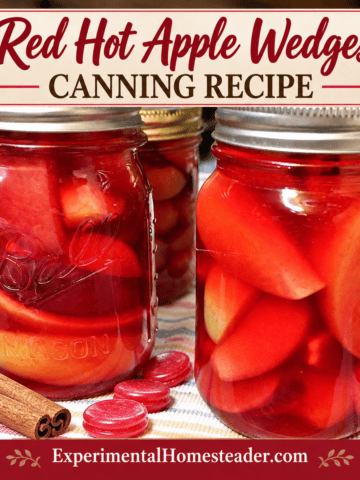
Apple Canning Recipes: How I Preserve Apples For Winter
I prefer to can apples even though it takes more work in the beginning.
For me, the payoff comes later. When I want apples for a pie, dessert, breakfast or another recipe, I can walk to the pantry, grab a jar and have apples ready to use without waiting for anything to thaw.
That's why having a few favorite apple canning recipes has always been important to me.
Over the years, I've canned apples with and without the peels and tried different ways of putting them up. Eventually, a friend gave me one of the simplest-and most useful-pieces of advice about preserving apples.
Instead of canning all of them for one specific recipe, can some apples in a simple syrup so you have more options later.
That made sense to me.
Now I can open a jar in the middle of winter and decide then whether those apples are becoming pie, fried apples, a dessert or something else entirely.

In This Article
Why Can Apples?
There are plenty of ways to preserve an apple harvest.
You can freeze apples, dehydrate them, turn them into applesauce or apple butter, or preserve them using a tested home-canning recipe.
I use more than one method, but I particularly like canning because properly processed jars are shelf-stable.
That matters when freezer space is limited, and it also means my entire apple supply isn't dependent on keeping a freezer running.
Canning does require more work on preservation day, but much of the preparation is already done when you're ready to use the apples.
That's a tradeoff I'm happy to make.
Do You Have To Peel Apples Before Canning?
Whether apples should be peeled depends on the tested recipe you're using.
I've canned apples both with and without their peels over the years, but when I'm following a tested canning recipe, I follow its preparation instructions-including whether it calls for the apples to be peeled.
For many recipes, peeling also gives you a more consistent finished texture.
And those apple peels don't necessarily have to go to waste.
Depending on their condition and what you're making, apple scraps can sometimes find another purpose in the kitchen or compost pile.
During apple season, I like getting as much use from the harvest as I reasonably can.
What Are The Best Apples For Canning?
Start with good-quality, firm apples.
Canning isn't a way to rescue fruit that's already spoiling. Bruised or damaged areas should be removed, and apples showing signs of decay shouldn't go into your canning jars.
The variety you choose can affect the finished texture and flavor.
Some apples soften more readily during processing, while firmer varieties tend to hold their shape better.
If you have access to several varieties, you can also decide which apples you prefer for fresh eating and which ones you like better after they've been preserved.
One of the benefits of preserving your own food is learning those little preferences over time.
A Brief History Of Home Canning
Canning has a fascinating history, and I think it's worth knowing where this food-preservation method came from.
In the late 1700s, the French government offered a substantial financial prize for a reliable method of preserving food for its military.
Nicolas Appert, a French confectioner, developed a method of preserving food in sealed containers using heat. His work was published in 1810, long before scientists fully understood why the process worked.
Food-preservation science has come an awfully long way since Appert's experiments.
That's important to remember when we're canning at home today.
We don't have to guess at processing methods, times, acidity or jar sizes. Modern tested recipes give us those instructions, and following them is an important part of safe home food preservation.
Start With A Tested Apple Canning Recipe
This is one place where I don't improvise.
When you're baking an apple pie, changing a spice or adding a little more sugar might affect the flavor.
Canning is different.
The ingredients, preparation method, jar size, headspace and processing instructions in a tested recipe work together.
That's why I recommend using current recipes from trusted home food-preservation sources and following the recipe as written.
The apple recipe I use below comes from a current Ball canning recipe, so I'm leaving those instructions intact.
Do Canning Jars Need To Be Sterilized First?
This is an area where home-canning recommendations are sometimes misunderstood.
Your jars need to be clean and prepared according to the tested recipe and processing method you're using.
Whether empty jars require pre-sterilization depends on the processing time.
For foods processed for 10 minutes or longer in a boiling-water canner, current home-canning guidelines do not require empty jars to be separately sterilized beforehand, according to the National Center for Home Food Preservation. They should still be clean and prepared according to the tested recipe. I personally prefer to sterilize my jars before filling them anyway, and that's the practice I continue to use in my own kitchen.
If a tested recipe has a processing time of less than 10 minutes, empty jars need to be sterilized first.
You can read more about sterilizing canning jars before you begin.
Most importantly, follow the jar preparation and processing directions that accompany the tested recipe you're using.
Why I Like Canning Apples In A Simple Syrup
I've tried quite a few apple recipes over the years.
Then a friend pointed out that apples canned in a simple syrup are incredibly versatile because you haven't committed the entire batch to one particular finished dish.
I realized she had a point.
If I preserve every apple as pie filling, then I have pie filling.
That's wonderful when I want pie - but not necessarily when I decide I'd rather make something else.
Apples preserved more simply give me choices.
I can open the jar later and turn those apples into whatever makes sense at the time.
That's the kind of food storage I find genuinely useful.
Apple Canning Recipe
Here is the apple canning recipe I use.
Apple Canning Recipes
Instructions
- Combine sugar and water in a stainless steel pan.
- Bring to a boil, stirring constantly.
- Once the sugar is dissolved, reduce the heat to low so the syrup remains warm.
- Fill clean, sterilized canning jars with apple quarters. Be sure to run your fingers around the tops of the jars before using them to check for tiny nicks. If you find any, those jars are no longer useful for canning.
- Cover the apples with the water and sugar syrup you just made. Leave ½ inch air space at the top of the jar.
- Wipe the top and edges of the jar with a clean, damp cloth.
- Put a clean, sterilized, new lid on the jar, add the band and screw it down until it is fingertip tight.
- Place the jars in a cold pack canner filled with boiling water.
- Process both pints and quarts for 20 minutes.
- Turn the heat off under the canning pot once the 20 minutes is up.
- Remove the lid, but allow the jars to sit under the water for 5 minutes longer.
- Carefully remove the jars. Set them aside and allow them to cool overnight.
- Remove the bands and check the seals by gently prying them with your fingertips.
- If the jars are sealed, replace the bands, label and store in a cool, dark, dry place.
- If the jars are not sealed you can either select a new lid and attempt to seal the jars again or put the food into your refrigerator and use it up.

What Can You Make With Canned Apples?
This is where all that work during apple season starts paying you back.
Having jars of apples on the shelf means much of the washing, peeling, coring, cutting and preserving has already been done.
Depending on the recipe you're making, canned apples can be used for things such as:
- Apple pie
- Apple cobbler
- Apple crisp
- Fried apples
- Muffins and quick breads
- Cakes and other apple desserts
- Pancake and waffle toppings
- Oatmeal
- Yogurt toppings
- Applesauce
- Sweet and savory dishes that pair well with apples
The texture isn't going to be identical to a crisp apple straight from the tree, of course. They've been processed.
That's why I especially like using canned apples in dishes where the apples would be cooked anyway.
Can You Use Canned Apples For Apple Pie?
Yes, canned apple slices can be very convenient when you're making an apple pie, provided they're appropriate for the particular pie recipe you're using.
Drain them as needed and follow your pie recipe from there.
This is one of the reasons I like preserving apples without turning every jar into prepared pie filling.
I can decide later what kind of pie or dessert I want to make.
When I'm ready for pie, a jar of prepared apples gets me part of the way there before I've even started.
Canning Apples Vs. Freezing Apples
I do both, but if I have the time, I prefer canning apples.
Freezing is certainly easier upfront. Prepare the apples, package them appropriately and put them into the freezer.
Canning requires the jars, canner, processing time and cleanup.
But after that work is finished, the jars sit on the shelf without taking up freezer space.
Frozen apples also depend on electricity for continued storage. Properly canned apples don't.
That doesn't make freezing a bad option. Sometimes I'm short on time and freezing is exactly what makes sense.
If that's where you are right now, my Freezing Apples Recipe walks you through that option.
For me, it's less about declaring one preservation method the winner and more about deciding what makes sense for the harvest, my available time and how I expect to use the food later.
Canning Apples Vs. Dehydrating Apples
Dehydrating gives you something entirely different.
Dried apple slices take up very little room and make wonderful snacks. They're also easy to pack for lunches and can be used in a variety of recipes.
Canned apples retain considerably more moisture and are ready for the kinds of recipes where you want soft apple slices.
Again, I don't think we have to choose.
A big apple harvest might give me jars of canned apples, containers of dehydrated apple slices and some apples tucked into the freezer.
If pantry-friendly dried apples sound useful, read my Beginner's Guide To Dehydrating Apples next.
Not Every Apple Has To Go Into The Canner
This is the contextual link I especially want to add while we're refreshing this apple cluster.
As much as I prefer canning, I don't can every apple I bring into the kitchen.
Some things are worth making simply because they're delicious.
If you have fresh apples left after your canning projects, try my Caramel Pecan Apple Butter Recipe.
It combines apples with warm fall spices, caramel and pecans for a rich spread that's delicious on toast, biscuits, pancakes, waffles and oatmeal.
Because of the pecans, I treat that particular version as a refrigerator or freezer recipe rather than assuming the processing instructions for traditional canned apple butter apply to it.
So if you've spent the day filling the pantry with jars of apples, Caramel Pecan Apple Butter is a fun way to use a few more apples for something you can start enjoying now.
How Should Home-Canned Apples Be Stored?
Once your jars have been processed according to the tested recipe, allow them to cool undisturbed as directed.
Check the seals before putting the jars into storage.
Labeling matters too.
At minimum, I want to know what's in the jar and when I canned it.
It seems completely obvious on canning day that you'll remember what everything is.
Six months later, surrounded by jars that suddenly look remarkably similar, you may be glad you wrote it down.
Store properly processed and sealed jars according to current home-canning storage recommendations, and periodically check your pantry inventory so older jars get used first.
If a jar ever shows signs of spoilage or has lost its seal during storage, don't taste the food to decide whether it's safe.
Keep Track Of What You're Preserving
Apple season can turn into a lot of jars surprisingly fast.
That's one reason keeping preservation records and pantry inventory is useful.
Record what you canned, when you canned it, the recipe you used and how many jars went into storage.
Then actually use those records when you're planning meals or deciding what needs to be preserved the following year.
If you canned 30 jars of apples and still have 20 when apple season rolls around again, that's useful information.
If you canned 12 and everyone is asking where the apples went by January, that's useful information too.
Food preservation becomes much more practical when we use what we learned from one harvest to plan the next one.
More Ways To Preserve And Use Apples
One of the best things about apple season is that you don't have to do the same thing with the entire harvest.
Freeze some apples for baking later.
Dehydrate some apples for snacks and pantry storage.
Use tested canning recipes to put shelf-stable apple products on the pantry shelves.
Make a batch of Caramel Pecan Apple Butter when you're craving something special.
And browse my Ultimate Apple Roundup when you're staring at another basket of apples and wondering what in the world you're going to make next.
I still prefer canning a good portion of my apples because I appreciate having those jars sitting on the pantry shelf all winter.
Yes, it's more work today.
But when I open a jar months later and most of the preparation has already been done?
That's when I'm glad I did it.