How To Make An Edible Chocolate Bowl
There is something especially fun about serving dessert in a bowl you can eat when you're finished.
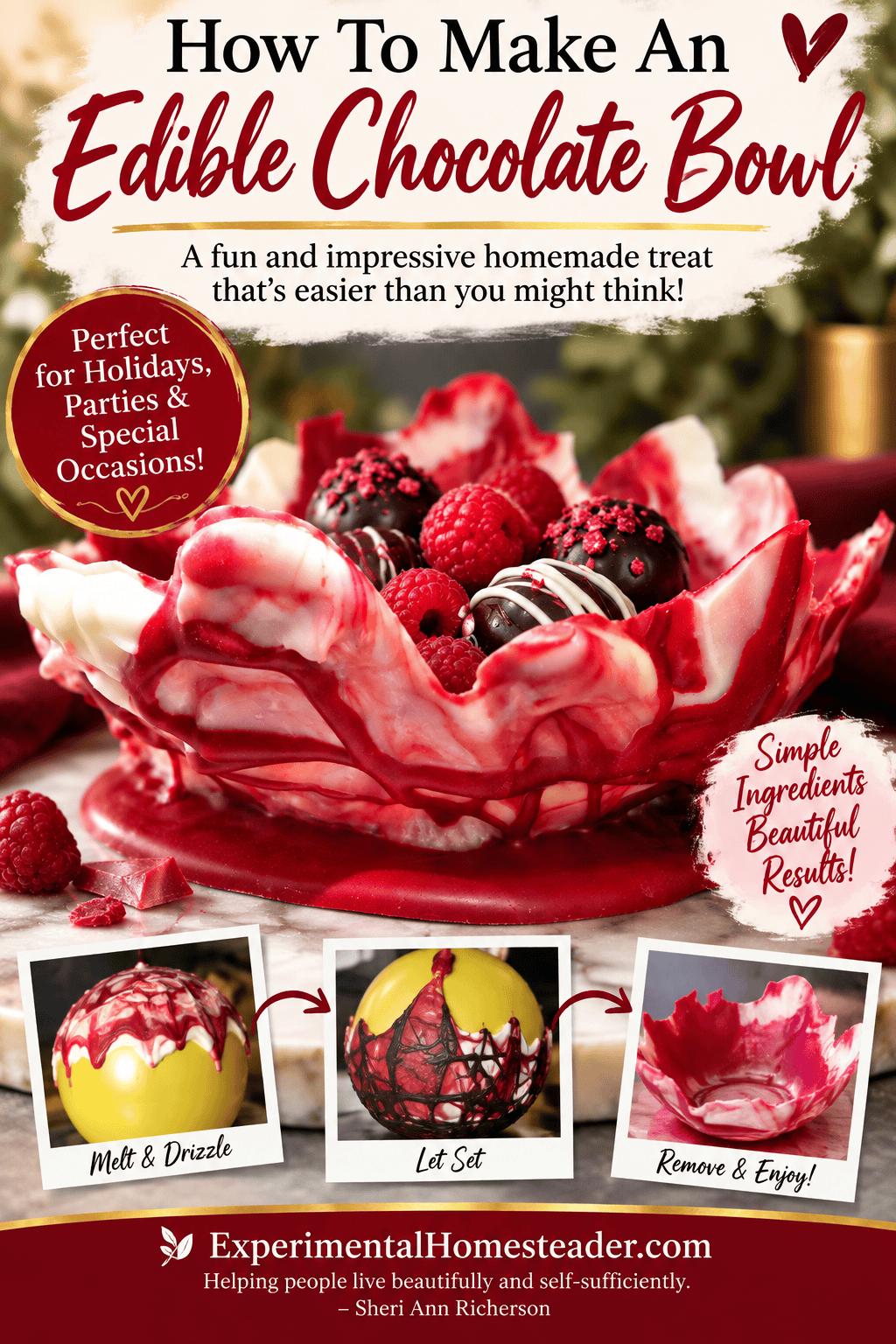
I originally made this edible chocolate bowl around Valentine's Day, which explains my choice of red and white chocolate. However, there is absolutely no reason to save this idea for Valentine's Day. Change the colors and fillings, and an edible chocolate bowl can become part of a birthday party, Christmas dessert table, bridal shower, anniversary dinner, baby shower or just a fun weekend dessert.
Fill it with ice cream, pudding, mousse, homemade candies, cookies, fresh fruit or whatever else sounds good.
The bowl itself becomes part of the dessert.
Now, before I make this project sound easier than it was, I need to tell you something.
The edible chocolate bowl you see in my photos was attempt number three.
There was some breakage. There were a few moments when the chocolate did not behave the way I expected it to. I even had to repair a hole after removing the balloon.
But I think it turned out pretty good.
And the nice thing about making mistakes when you're working with chocolate is that you can eat the evidence.
After three attempts, I learned quite a bit about what worked, what didn't and where the bowl was most likely to break. I'm sharing all of those little tips with you because hopefully they'll help you get yours right the first time.
In This Article
What You Need To Make An Edible Chocolate Bowl
You don't need a special chocolate mold for this project.
The mold is simply a balloon.
I used:
- One new balloon
- Chocolate candy wafers in the colors of your choice
- Microwave-safe containers or a double boiler
- Spoons
- Bamboo skewers, if desired
- Parchment paper or wax paper
- A small plastic cup to hold the balloon upright
- Scissors
I used glass measuring cups to melt my chocolate.
I also used bamboo skewers for stirring because they were handy, although spoons work just as well. If you're working with several colors of chocolate, make sure you have a separate spoon or skewer for each color unless you intentionally want to mix them.
The colors are completely up to you.
I used white and red chocolate for this particular bowl and also experimented with black chocolate on another one.
That ability to change the colors is one of the things that makes this project so versatile.
Choosing A Balloon For Your Chocolate Bowl
A balloon under six inches is ideal if you want a smaller individual dessert bowl.
Mine was about nine inches because that was the smallest balloon I could find at the time.
It worked.
It just gave me a larger bowl.
I wouldn't inflate the balloon as tightly as possible. You need enough air to give you the size and shape you want, but you don't need to stretch it to its absolute limit.
Once I had my balloon inflated, I washed the outside of it and dried it thoroughly before allowing it to come into contact with the chocolate.
Then I placed the tied end into a small plastic cup.
The cup is important because once you start putting chocolate onto the balloon, it becomes top-heavy. You don't want your chocolate-covered balloon tipping over halfway through the project.
I learned that lesson during one of my earlier attempts.
A Safety Note About Using Balloons With Food
Because the balloon comes into direct contact with something you're going to eat, I think this deserves more than a passing mention.
I used a new balloon, inflated it first, and then thoroughly washed and dried the exterior.
You should also consider latex allergies.
Many common balloons are made from natural rubber latex. If you have a latex allergy or are making the dessert for someone who does, I would not use a latex balloon as a food mold.
Also, don't put extremely hot chocolate onto an inflated balloon.
Melt your candy wafers according to their package directions and work with the coating once it is smoothly melted and at a comfortable working consistency.
Melt The Chocolate Candy Wafers
Melt each color of candy wafers separately according to the manufacturer's directions.
You can use microwave-safe containers or a double boiler.
One thing I discovered while making my bowls was that the different colors didn't necessarily behave exactly the same.
My red chocolate melted much runnier than my white chocolate.
At first, I wasn't sure that was a good thing.
It turned out to be helpful.
The thinner red chocolate encouraged the thicker white chocolate to start flowing down the sides of the balloon.
This is one of those projects where you have to pay attention to what the chocolate is doing rather than expecting every color and every drip to behave identically.
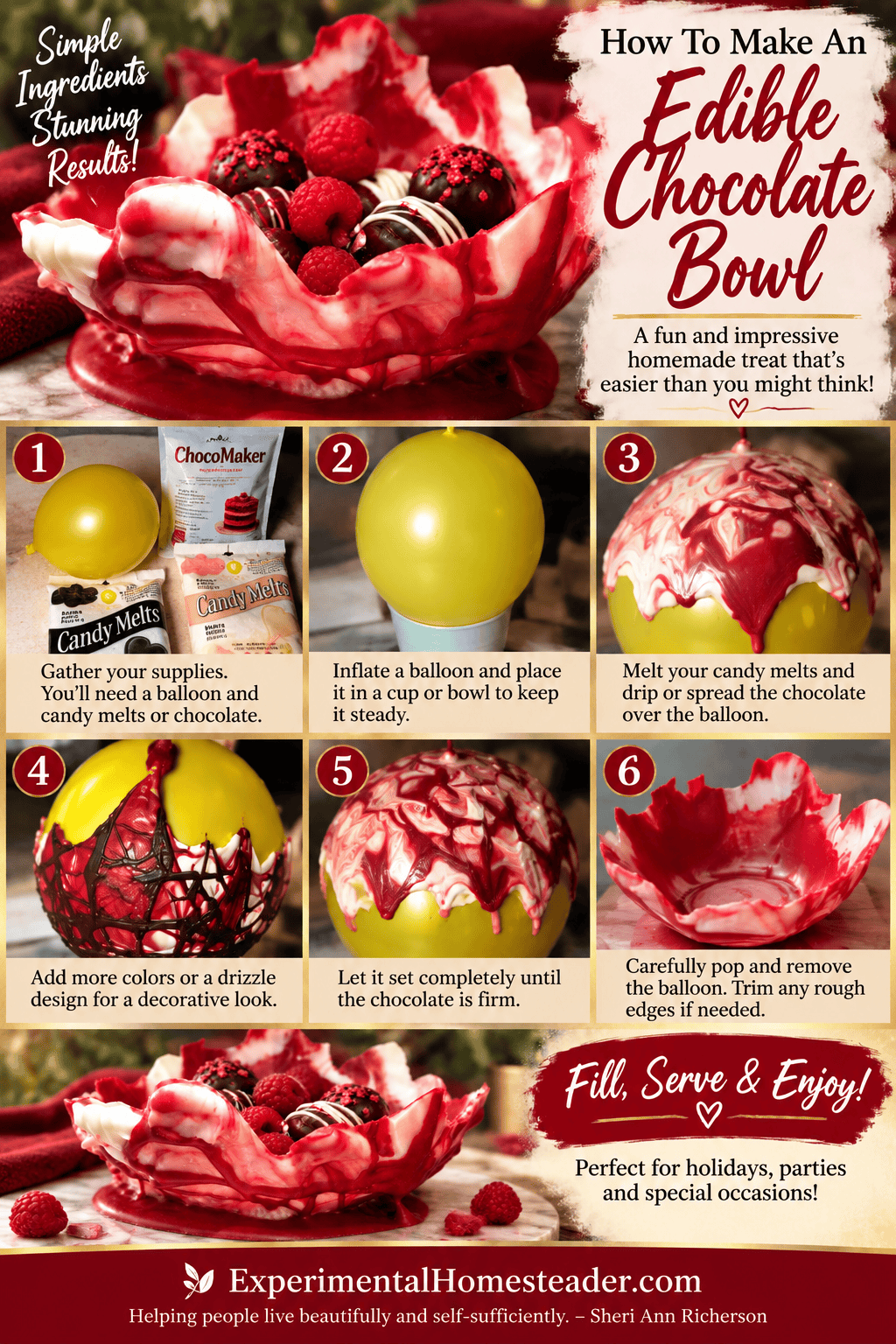
Begin Building The Chocolate Bowl
I started by putting two big dollops of white chocolate on top of the balloon.
I spread the chocolate out slightly and then added two dollops of red chocolate.
Then I continued adding chocolate in this fashion.
As you work, gravity begins pulling the melted chocolate down the curved sides of the balloon.
This is where you begin creating the actual shape of your bowl.
And I really do mean creating it.
You're not simply dumping melted chocolate over a balloon and hoping for the best.
You're sculpting it.
Watch Those Chocolate "Fingers"
As the chocolate travels down the balloon, you'll see long drips begin to form.
I thought of them as chocolate fingers.
They can create beautiful, irregular edges on the finished bowl, but this is also one of the places where I ran into trouble.
The longer those chocolate fingers become, the thinner they become.
The thinner they are, the more likely they are to break once the balloon is no longer there to support them.
Keep an eye on them.
If one gets too long, use your spoon to scoop some of the chocolate away and move it somewhere else.
You can add that chocolate to an area that looks thin or use it to strengthen another section of the bowl.
Don't be afraid to add more chocolate where you need it.
A paper-thin chocolate bowl might look delicate and beautiful, but it isn't going to look nearly as beautiful when it breaks into six pieces during balloon removal.
You need enough chocolate to give the finished bowl some structure.
Add Your Decorative Chocolate
Once I was happy with the basic shape and the first chocolate had stopped running, I drizzled another color over the bowl.
For this one, I used red.
On another chocolate bowl, I experimented with black.
This is another place where you can make the bowl your own.
Drizzle lines back and forth. Create loops. Cross one color over another. Let some of the chocolate run naturally.
You're making a handmade chocolate bowl.
It doesn't need to look like something that rolled off a factory assembly line.
In fact, I think the irregular edges and drizzles are part of what makes it interesting.
Just don't use every last bit of your melted chocolate.
Save a couple of spoonfuls for the base.
Make A Base For The Edible Bowl
Once you're happy with the bowl itself, lay a small sheet of parchment paper or wax paper on your work surface.
Pour the remaining melted chocolate onto the paper and form a circle.
This is going to become the base of your bowl.
Carefully lift your balloon from the plastic cup.
Support it as you move it because you now have quite a bit of chocolate sitting on top of it.
Place the rounded chocolate-covered portion of the balloon into the circle of melted chocolate.
As everything hardens, that circle becomes a flat base that allows your finished chocolate bowl to sit upright.
Now comes one of the hardest parts.
Leave it alone.
Give The Chocolate Plenty Of Time To Harden
I allowed mine to sit for approximately two hours.
You want that chocolate completely hardened before you begin removing the balloon.
After the chocolate had set, I placed the balloon and chocolate bowl in the refrigerator on the parchment paper for approximately 10 minutes.
That short chill helped firm everything before I attempted to remove the balloon.
Don't rush this part.
If the chocolate still feels soft, give it more time.
Removing the balloon is stressful enough without trying to do it while your chocolate is still flexible.
How To Remove The Balloon Without Destroying The Chocolate Bowl
This is probably the most important technique I learned.
Don't simply pop the balloon.
Instead, I started by gently pressing the balloon away from the chocolate around the pointed edges of the bowl.
What I was trying to do was create a little space between the balloon and the chocolate.
Those points are some of the most fragile areas of the bowl. If the balloon is stuck to them and suddenly pulls away, they're likely to snap.
Once I had loosened as many areas as I could, I carefully made a tiny hole in the balloon as close as possible to the tied end.
Then I held the hole mostly closed with my fingers.
I allowed just a tiny amount of air to escape at a time.
As the balloon slowly deflated, I watched the chocolate carefully.
If I saw a place where the balloon wasn't releasing from the chocolate, I stopped and gently worked that area loose before allowing more air to escape.
It takes longer than popping the balloon.
But after making it all the way to this point, I'd rather spend another few minutes carefully deflating the balloon than watch the entire bowl shatter.
Eventually, the balloon collapsed enough that I could completely remove it.
What If The Chocolate Bowl Breaks?
Mine did.
Not completely, thankfully.
But after I removed the balloon, I discovered a hole that needed to be repaired.
I had a small, thin piece of chocolate that had broken off during the balloon removal, so I decided to use it as a patch.
Using a bamboo skewer, I spread a little melted chocolate around the outside edge of the hole.
Then I carefully pressed the broken piece of chocolate into place.
I continued adding melted chocolate until the patch was secure.
Then I worked from the inside of the bowl.
I added a little more melted chocolate over the repaired area and smoothed it as carefully as I could so the patch wasn't obvious.
You have to be gentle when doing this because you don't want to knock the patch loose while you're working on the other side.
Once I was happy with it, I put the bowl back into the refrigerator and let the repaired area harden.
And that was it.
The bowl survived.
Don't Expect Handmade To Mean Perfect
This is one of those projects where perfection can get in the way of having fun.
My finished bowl wasn't flawless.
It took three tries.
I had breakage.
I had to repair a hole.
And I still loved the way it turned out.
If you're making one of these with your children or grandchildren, experimenting with different colors for a party, or simply trying something new in your own kitchen, don't get discouraged if your first one doesn't look exactly the way you imagined.
You're working with melted chocolate, gravity and a balloon.
Things happen.
And unlike a lot of DIY mistakes, this one is edible.

Edible Chocolate Bowl Ideas For Different Occasions
One of the reasons I like this project so much is that you can completely change the look without changing the basic technique.
The red and white bowl I made is perfect for Valentine's Day, but that's only one possibility.
Valentine's Day
Use red, pink and white chocolate and fill the bowl with strawberries, raspberries, chocolate truffles, homemade candies or a rich chocolate mousse.
It would also make a fun edible centerpiece for a Valentine's dessert table.
Birthdays
Match the chocolate colors to the birthday decorations.
Fill the bowl with ice cream, cookies, candies or brownie bites.
For a child's birthday, you could even make several smaller bowls and let each person have an edible dessert bowl of their own.
Christmas
Red, green and white immediately turn this into a Christmas dessert.
Gold or silver accents could make it look even more festive.
Fill it with homemade Christmas candies, truffles, cookies or other holiday treats.
Halloween
This could be really fun.
Try orange and black, purple and black, or green and black chocolate.
Irregular drips that look imperfect for another occasion could suddenly look wonderfully creepy for Halloween.
Easter
Pastel pink, yellow, blue, lavender and white would make a beautiful Easter chocolate bowl.
Fill it with homemade Easter candy or other small treats.
Bridal Showers And Weddings
White chocolate with gold, silver or colors that coordinate with the wedding could create a beautiful dessert-table centerpiece.
Smaller individual bowls could also be used for mousse or other desserts.
Baby Showers
Pastels work beautifully here too.
Match the colors to the shower decorations and fill the bowl with candies or cookies.
Anniversaries And Romantic Dinners
You don't need Valentine's Day as an excuse for chocolate.
A dark chocolate and white chocolate bowl filled with strawberries or a favorite homemade dessert could make an ordinary dinner feel much more special.
Everyday Desserts
And sometimes you don't need an occasion at all.
Make one because the kids want ice cream.
Make one because you're serving homemade pudding.
Make one because you want to see whether you can do it.
That's a perfectly good reason too.
What Can You Put In An Edible Chocolate Bowl?
Once you've successfully removed the balloon, the fun really begins.
Depending on the size of your bowl, try filling it with:
- Ice cream
- Pudding
- Chocolate mousse
- Fresh strawberries
- Raspberries
- Blueberries
- Homemade truffles
- Cookies
- Brownie bites
- Homemade candies
- Fudge
- Marshmallows
- Chocolate-covered fruit
- Small pieces of cake
- A combination of fresh fruit and chocolate
If you're using a wet filling such as ice cream, mousse or pudding, I recommend filling the bowl close to serving time rather than letting the dessert sit in the chocolate bowl for hours.
And don't put anything hot into it.
After spending all that time creating your edible serving bowl, the last thing you want to do is melt it.

Love Chocolate? Discover The Chocolate Lover's Garden
If chocolate fascinates you beyond the kitchen, explore The Chocolate Lover's Garden by Sheri Ann Richerson and Tom Ogren. It's a natural next step for chocolate lovers who want to discover the plants and garden inspiration behind the flavors they love.
Frequently Asked Questions About Making Chocolate Bowls
Can You Use A Regular Balloon To Make A Chocolate Bowl?
I used a regular new balloon.
I inflated the balloon first and then washed and thoroughly dried the exterior before putting chocolate on it.
Keep in mind that many balloons are made from natural rubber latex. If you or the person you're serving has a latex allergy, don't use a latex balloon as a food mold.
Should You Wash The Balloon Before Putting Chocolate On It?
I did.
I blew mine up first, washed the exterior and dried it thoroughly.
Since the balloon is going to come into direct contact with food, this is a step I wouldn't skip.
Why Did My Chocolate Bowl Break?
The chocolate may be too thin, particularly around the long drips or decorative points.
The chocolate may also not have hardened completely before you started removing the balloon.
Another possibility is that the balloon is still stuck to the chocolate.
Gently separating the balloon from the fragile areas before deflating it made a big difference for me.
Should You Pop The Balloon To Remove It?
I wouldn't.
I made a tiny hole near the tied end and slowly released the air while watching for places where the balloon was sticking to the chocolate.
This gave me much more control.
How Do You Keep The Balloon From Falling Over?
I placed the tied end of my inflated balloon into a small plastic cup.
Once you start adding chocolate, the balloon becomes surprisingly top-heavy, so make sure the container you're using is stable.
Why Is One Color Of My Candy Melts Thinner Than Another?
I experienced this myself.
My red chocolate was noticeably runnier than my white chocolate.
Different candy coatings can behave a little differently when melted. Follow the manufacturer's melting directions and work with the consistency you have.
In my case, the thinner red chocolate actually helped the thicker white chocolate flow over the balloon.
Can You Use Regular Chocolate Instead Of Candy Wafers?
You can make molded chocolate decorations with real chocolate, but real chocolate behaves differently than candy coating.
Properly tempered chocolate gives you a better snap and more stable finished result. Candy wafers are much more forgiving if you're new to working with chocolate, which is one reason they're a good choice for this project.
Can You Repair A Broken Chocolate Bowl?
Small breaks may be repairable.
Mine was.
I used a broken piece of chocolate as a patch and melted chocolate as the "glue." Then I reinforced the area from both sides and allowed it to harden again.
If the bowl completely shatters, however, repairing it may not be practical.
At that point, I recommend eating the evidence and trying again.
How Long Does A Chocolate Bowl Need To Harden?
I allowed mine to sit for approximately two hours and then refrigerated it for about 10 minutes before removing the balloon.
The important thing is that the chocolate is completely firm before you begin deflating the balloon.
Can I Make An Edible Chocolate Bowl Ahead Of Time?
Yes.
Once the bowl is completely hardened and the balloon is removed, keep it in a cool, dry place away from heat, sunlight, humidity and strong odors.
How long it keeps will depend in part on the chocolate or candy coating you use, so check the manufacturer's storage recommendations.
Can Kids Make Chocolate Bowls?
This can be a fun project for children with adult supervision.
Adults should handle any steps involving hot melted chocolate, scissors and balloon removal as appropriate for the child's age.
What Is The Best Filling For A Chocolate Bowl?
There really isn't one.
That's part of what makes these so much fun.
Ice cream is probably the most obvious choice, but mousse, pudding, fresh berries, homemade candy, cookies and truffles are all wonderful options.
Choose something that works with the flavor and colors of the chocolate you used.
Is An Edible Chocolate Bowl Worth Making?
I think so.
Mine took me three tries.
It broke a little.
I repaired it.
And I would still make another one.
There's something satisfying about taking a handful of candy wafers and a balloon and ending up with an actual edible serving bowl.
Don't worry if yours isn't perfect.
Pay attention to the thickness of your chocolate, give it plenty of time to harden and, most importantly, take your time when you remove the balloon.
And if the first one doesn't work?
You know what I'm going to say.
Eat the evidence and try again.
Print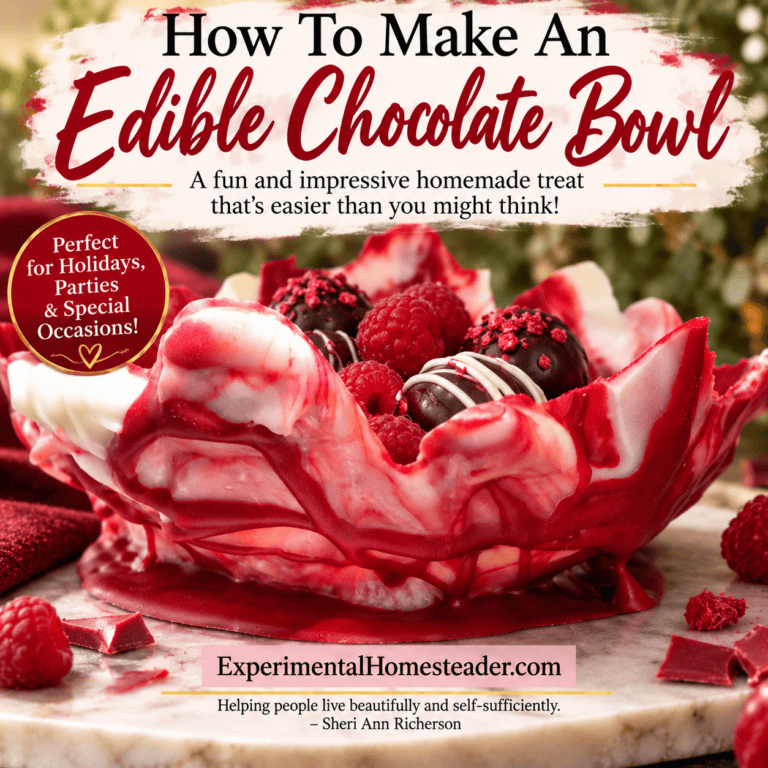
How To Make An Edible Chocolate Bowl
- Total Time: About 2 hours 10 minutes
- Yield: 1 edible chocolate bow 1x
Ingredients
- White chocolate candy wafers, as needed
- Red chocolate candy wafers, as needed
- Black or another contrasting color of chocolate candy wafers, optional
Instructions
- Inflate a new balloon to the desired size. Wash and thoroughly dry the outside of the inflated balloon.
- Place the tied end of the balloon into a small plastic cup so the balloon remains upright.
- Melt each color of chocolate candy wafers separately according to the package directions.
- Spoon generous dollops of the first color onto the top of the balloon. Add the second color and allow the chocolate to begin flowing down the sides.
- Continue adding and sculpting the chocolate. If any drips become very long and thin, scoop some of the chocolate away or reinforce the area with additional melted chocolate.
- Once you're happy with the shape of the bowl, drizzle another color of melted chocolate over it to create the desired design.
- Reserve a small amount of melted chocolate for the base.
- Place parchment or wax paper on your work surface. Pour the reserved chocolate onto the paper to create a circle.
- Carefully lift the balloon from the cup and place the rounded chocolate-covered portion into the circle of melted chocolate.
- Allow the chocolate to harden for approximately two hours.
- Refrigerate the chocolate-covered balloon for approximately 10 minutes to help firm the chocolate.
- Gently separate the balloon from the delicate edges of the chocolate.
- Make a tiny hole near the tied end of the balloon and slowly release the air. Stop whenever necessary to gently separate the balloon from chocolate that is still sticking.
- Remove the completely deflated balloon.
- If necessary, repair small holes or cracks with melted chocolate and allow the repairs to harden.
- Fill the finished edible chocolate bowl with your favorite dessert and enjoy.


Notes
-
Use a new balloon and wash and dry the exterior after inflating it. Be mindful of latex allergies when using latex balloons as food molds.
Do not apply extremely hot chocolate to an inflated balloon. Melt candy wafers according to their package directions and allow them to reach a workable consistency.
Don't rush balloon removal. Slowly deflating the balloon gives you time to release any areas that remain stuck to the chocolate and can help prevent breakage.
The colors can be changed for holidays, birthdays, weddings, showers and other special occasions.